Atlassian uses cookies to improve your browsing experience, perform analytics and research, and conduct advertising. Accept all cookies to indicate that you agree to our use of cookies on your device. Atlassian cookies and tracking notice, (opens new window)
This Snap executes an SQL update with the given properties. Keys from the document will be used as the columns to update and their values will be the updated value in the column.
Updates will be batched up until the account's batch size property or until the structure of the update statement changes. An update statement will change if an incoming document contains different keys than a previous document.
Expected upstream Snaps: The data to be updated in the table can be defined by providing values upstream. The document generator Snaps like JSON Generator can be used in upstream. Expected downstream Snaps: The Snap will output one document for every record updated, hence any document processing Snap can be used down stream.
This Snap uses account references created on the Accounts page of SnapLogic Manager to handle access to this endpoint. See Configuring SAP HANA Accounts for information on setting up this type of account.
Views:
Input
This Snap has exactly one input view.
Output
This Snap has at most one output view. If an output view is available, then the original document that was used to create the statement will be output with the status of the update.
Error
This Snap has at most one error view and produces zero or more documents in the view.
Database Write Snaps output all records of a batch (as configured in your account settings) to the error view if the write fails during batch processing.
Settings
Label
Required. The name for the Snap. You can modify this to be more specific, especially if you have more than one of the same Snap in your pipeline
Schema name
The database schema name. In case it is not defined, then the suggestion for the table name will retrieve all tables names of all schemas. The property is suggestible and will retrieve available database schemas during suggest values.
The values can be passed using the pipeline parameters but not the upstream parameter.
Example: myschema
Default value: [None]
Table name
Required.The name of the table to execute the update operation on.
The values can be passed using the pipeline parameters but not the upstream parameter.
Example: people
Default value: [None]
Update condition
Specify the SQL WHERE clause of the update statement. You can define specific values or columns to update (Set condition) in the upstream Snap, such as Mapper Snap, and then use the WHERE clause to apply these conditions on the columns sourced from the upstream Snap. For instance, here is a sample of an Update SQL query:
UPDATE table_name SET column1 = value1, column2 = value2, WHERE condition;
If theUpdate Conditionfield is left blank, the condition is applied on all the records of the target table.
In certain scenarios where you want to use specific data from the upstream Snaps, and do not want to change that data in the Update Snap, then you need to place the data in the original structure of the input document. Hence, we recommend that you use the format for Update condition and input data format as shown below:
Instead of building multiple Snaps with inter dependent DML queries, it is recommended to use the SAP HANA - Stored Procedure Snap. In a scenario where the downstream Snap depends on the data processed in an Upstream Database Bulk Load Snap, use the Script Snap to add delay for the data to be available.
Refer to theexampleto understand how to use the Update Condition.
"EMPNO=" + $EMPNO + " and ENAME='" + $EMPNAME+ "'"
Caution
Using expressions that join strings together to create SQL queries or conditions has a potential SQL injection risk and is hence unsafe. Ensure that you understand all implications and risks involved before using concatenation of strings with '=' Expression enabled.
Default value: [None]
Number of retries
Specifies the maximum number of attempts to be made to receive a response. The request is terminated if the attempts do not result in a response.
Example: 3
Default value: 0
If the value is larger than 0, the Snap first downloads the target file into a temporary local file. If any error occurs during the download, the Snap waits for the time specified in the Retry interval and attempts to download the file again from the beginning. When the download is successful, the Snap streams the data from the temporary file to the downstream Pipeline. All temporary local files are deleted when they are no longer needed.
Ensure that the local drive has sufficient free disk space to store the temporary local file.
Retry interval (seconds)
Specifies the time interval between two successive retry requests. A retry happens only when the previous attempt resulted in an exception.
Example: 10
Default value: 1
Snap execution
Select one of the three modes in which the Snap executes. Available options are:
Validate & Execute: Performs limited execution of the Snap, and generates a data preview during Pipeline validation. Subsequently, performs full execution of the Snap (unlimited records) during Pipeline runtime.
Execute only: Performs full execution of the Snap during Pipeline execution without generating preview data.
Disabled: Disables the Snap and all Snaps that are downstream from it.
In a scenario where the Auto commit on the account is set to true, and the downstream Snap does depends on the data processed on an Upstream Database Bulk Load Snap, use the Script Snap to add delay for the data to be available.
For example, when performing a create, insert and a delete function sequentially on a pipeline, using a Script Snap helps in creating a delay between the insert and delete function or otherwise it may turn out that the delete function is triggered even before inserting the records on the table.
Examples
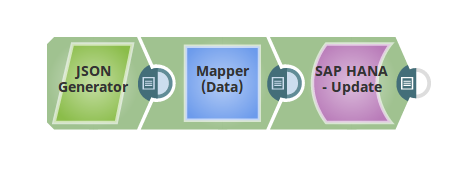
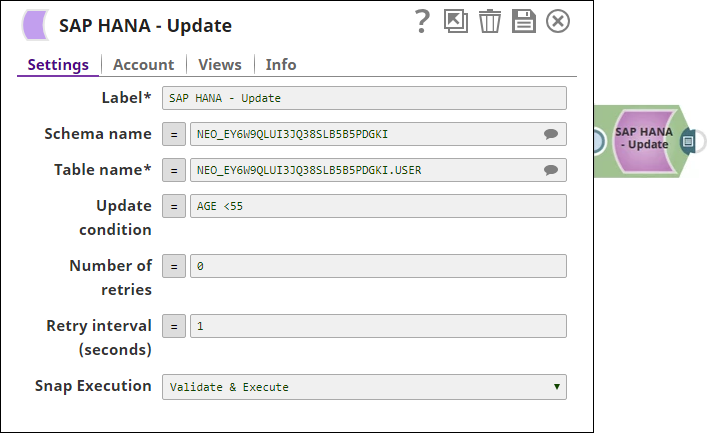
The following example updates the city of users in the "USER" table based on the update condition (age < 55).
The update values are passed from upstream using JSON Generator. The update condition here will specify the condition to identify the records to be updated.
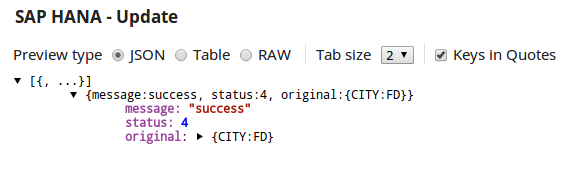
The sample output of update Snap looks like:
Snap Pack History
Click to view/expand
Release
Snap Pack Version
Date
Type
Updates
February 2025
main29887
Stable
Updated and certified against the current SnapLogic Platform release.
November 2024
main29029
Stable
Updated and certified against the current SnapLogic Platform release.
August 2024
main27765
Stable
Updated and certified against the current Snaplogic Platform release.
May 2024
437patches26690
Latest
Fixed an issue in the SAP HANA Snap Pack where the downstream Snaps did not support the data type appropriately.
May 2024
main26341
Stable
Updated the Delete Condition (Truncates a Table if empty) field in the SAP HANA - DeleteSnap to Delete condition (deletes all records from a table if left blank) to indicate that all entries will be deleted from the table when this field is blank, but no truncate operation is performed.
February 2024
main25112
Stable
Updated and certified against the current SnapLogic Platform release.
November 2023
main23721
Stable
Updated and certified against the current SnapLogic Platform release.
August 2023
main22460
Stable
The SAP HANA - Execute Snap now includes a new Query type field. When Auto is selected, the Snap tries to determine the query type automatically.
May 2023
main21015
Stable
Upgraded with the latest SnapLogic Platform release.
February 2023
main19844
Stable
Upgraded with the latest SnapLogic Platform release.
November 2022
main18944
Stable
The SAP HANA Insert Snap now creates the target table only from the table metadata of the second input view when the following conditions are met:
The Create table if not present checkbox is selected.
The target table does not exist.
The table metadata is provided in the second input view.
October 2022
430patches18852
Latest
SAP HANA Snaps now properly handle lineage when used in Ultra Pipelines.
August 2022
main17386
Stable
Upgraded with the latest SnapLogic Platform release.
4.29
main15993
Stable
Upgraded with the latest SnapLogic Platform release.
4.28
main14627
Stable
Updated the label for Delete Condition to Delete Condition (Truncates Table if empty) in the SAP HANA DeleteSnap
Upgraded with the latest SnapLogic Platform release.
4.25
main9554
Stable
Upgraded with the latest SnapLogic Platform release.
4.24
main8556
Stable
Enhanced the SAP HANA - SelectSnap to return only the selected output fields or columns in the output schema (second output view) using the Fetch Output Fields In Schema check box. If the Output Fields field is empty all the columns are visible.
Enhanced the SAP HANA - Stored Procedure to accept parameters from input documents by column keys. If the values are empty, the parameters are populated based on the column keys for easier mapping in the upstream Mapper Snap.
4.23 Patch
423patches7548
Latest
Fixed the batch size issue inSAP HANA - UpsertSnap by using a prepare statement when sending the batch request.
4.23
main7430
Stable
Upgraded with the latest SnapLogic Platform release.
4.22 Patch
422patches6940
Latest
Fixed the stored procedure name conflict issue in the SAP HANA - Stored Procedure Snap, when the stored procedure exists in multiple schemas, by parsing each procedure name.
4.22
main6403
Stable
Upgraded with the latest SnapLogic Platform release.
4.21 Patch
421patches6272
Latest
Fixed the issue whereSnowflake SCD2Snap generates two output documents despite no changes toCause-historizationfieldswithDATE, TIME and TIMESTAMPSnowflake data types, and withIgnore unchanged rowsfield selected.
4.21 Patch
421patches6144
Latest
Fixed the following issues with DB Snaps:
The connection thread waits indefinitely causing the subsequent connection requests to become unresponsive.
Connection leaks occur during Pipeline execution.
4.21
snapsmrc542
Stable
Upgraded with the latest SnapLogic Platform release.
4.20
snapsmrc535
Stable
Reverted the SAP/HANA Snap Pack to the stable version snapsmrc535.
4.19 Patch
db/saphana8411
Latest
Fixed an issue with the SAP HANA - Update Snap wherein the Snap is unable to perform operations when:
An expression is used in theUpdate conditionproperty.
Input data contain the character '?'.
4.19
snaprsmrc528
Stable
Upgraded with the latest SnapLogic Platform release.
4.18
snapsmrc523
Stable
Upgraded with the latest SnapLogic Platform release.
4.17
ALL7402
Latest
Pushed automatic rebuild of the latest version of each Snap Pack to SnapLogic UAT and Elastic servers.
4.17
snapsmrc515
Latest
Fixed an issue with the SAP HANA Execute Snap wherein the Snap would send the input document to the output view even if the Pass through field is not selected in the Snap configuration. With this fix, the Snap sends the input document to the output view, under the key original, only if you select the Pass through field.
Added the Snap Execution field to all Standard-mode Snaps. In some Snaps, this field replaces the existing Execute during preview check box.
4.16 Patch
db/saphana7062
Latest
Fixed an issue in SAP HANA Update and Insert Snaps wherein time data type was not getting passed if a table name and column name were similar in multiple schemas.
4.16 Patch
db/saphana7040
Latest
Fixed an issue with the SAP HANA - Delete Snap wherein the Snap was unable to delete a data if the delete condition was not selected or if the condition was a static value.
4.16
snapsmrc508
Stable
Upgraded with the latest SnapLogic Platform release.
4.15
snapsmrc500
Stable
Upgraded with the latest SnapLogic Platform release.
4.14
snapsmrc490
Stable
Upgraded with the latest SnapLogic Platform release.
4.13
snapsmrc486
Stable
Upgraded with the latest SnapLogic Platform release.
4.12
snapsmrc480
Stable
Upgraded with the latest SnapLogic Platform release.
4.11
snapsmrc465
Stable
Upgraded with the latest SnapLogic Platform release.
4.10
snapsmrc414
Stable
AddedAuto commitproperty to the Select and Execute Snaps at the Snap level to support overriding of theAuto commitproperty at the Account level.
4.9.0 Patch
saphana3074
Latest
Fixed an issue regarding connection not closed after login failure; Expose autocommit for "Select into" statement in PostgreSQL Execute Snap and Redshift Execute Snap
4.9
snapsmrc405
Stable
Upgraded with the latest SnapLogic Platform release.
4.8.0 Patch
saphana2759
Latest
Potential fix for JDBC deadlock issue.
4.8.0 Patch
saphana2714
Latest
Fixed SAP HANA Snap Pack rendering dates that are one hour off from the date returned by database query for non-UTC Snaplexes.
4.8
snapsmrc398
Stable
Info tab added to accounts.
Database accounts now invalidate connection pools if account properties are modified and login attempts fail.
4.7.0 Patch
saphana2202
Latest
Fixed an issue for database Select Snaps regarding Limit rows not supporting an empty string from a pipeline parameter.
4.7
snapsmrc382
Stable
Upgraded with the latest SnapLogic Platform release.
4.6
snapsmrc362
Stable
Upgraded with the latest SnapLogic Platform release.
4.5.1
snapsmrc344
Latest
Fixed an error in a tooltip for SAP HANA Upsert.
4.5
snapsmrc344
Stable
NEW! SAP HANA - Table List: This Snap outputs a list of tables in a database.
Output fields property added to SAP HANA Select Snap.
Resolved an issue in SAP HANA Write Snap to disallow insertion of unsupported data types as NULLs in HANA tables.
Resolved an issue in SAP HANA Execute Snap that occurred when errors were reported even when table creation was successful.
4.22
NA
NA
NA
Ignored empty result added to Execute and Select Snaps. The option will not any document to the output view for select statements.
NA
NA
NA
Addressed the following issues:
Mismatched datatype values are inserted as NULLs
JSON paths in WHERE clauses should be processed as bind values after the expression is evaluated.
NA
NA
NA
Addressed the following issue: When schema name entered in lower case- click on suggest for table name- says - no tables found
Dynamic DB queries now supported in the Execute Snap.
The SQL statement property now can be set as an expression property. When it is an expression, it will be evaluated with each input document and one SQL statement per each input document will be executed.
Known issue: When the SQL statement property is an expression, the pipeline parameters are shown in the suggest, but not the input schema.
With the SQL statement property set as an expression, the Snap can be exposed to SQL injection. Please use this feature with caution.
SAP Hana Insert string into number no longer routes to error view - just inserts null
NA
NA
NA
SAP HANA Stored Procedure
Insert: Issue resolved with failing to write a string "NaN" to a string datatype column in HANA.