Oracle - Stored Procedure
- Kalpana Malladi
- Aparna Tayi (Unlicensed)
- Anand Vedam
On this Page
Overview
You can use this Snap to execute stored procedures in an Oracle database and write OUT parameter values to the output view. If an OUT parameter is:
Custom type OBJECT, then the output is displayed as a JSON object.
Custom type TABLE, then the output is displayed as a JSON array.
This Snap supports executing stored functions with OUT and INOUT parameters and writes these parameters in the output view along with the returnval key.
Snap type: | Write | |||||||
|---|---|---|---|---|---|---|---|---|
Examples: | Example 1: Stored procedure has output parameters firstName, lastName and both are of built-in type VARCHAR2. The output document is: {
firstName: "John",
lastName: "Smith"
}
Example 2: Stored procedure has three output parameters firstName, lastName, and hobbies where firstName and lastName are of built-in type VARCHAR2 and hobbies is of custom type TABLE. The output document is: {
firstName: "John",
lastName: "Smith",
hobbies:[
"swimming",
"reading",
"joking"
]
}
Example 3: Stored procedure has three output parameters firstName, lastName, and location where firstName and lastName are of built-in type VARCHAR2 and location is of custom type OBJECT. The output document is: {
firstName: "John",
lastName: "Smith",
location: {
"ADDRESS":"1520 8th Ave N",
"CITY":"San Mateo",
"STATE":"CA"
}
}
Example 4: Stored function accepts a customerId (NUMBER) and returns the customer's name (VARCHAR2).
The attribute names of OBJECT are not displayed with the default JDBC driver. With a custom JDBC driver, they are displayed as Field1, Field2, Field3, etc. User-defined types are only supported with a specific version of the JDBC driver. Refer to the JDBC Driver setting in Oracle Account. There is a limitation in Oracle JDBC driver that prevents the passing of a record type parameters to the stored procedure. Refer the link: http://docs.oracle.com/cd/E11882_01/java.112/e16548/apxref.htm#JJDBC28928 A workaround could be to write a wrapper stored procedure to avoid passing of record type parameter directly to the original stored procedure. | |||||||
| Known Issues | ||||||||
| Support for Ultra pipelines | Works in Ultra Tasks. | |||||||
| Account: | This Snap uses account references created on the Accounts page of SnapLogic Manager to handle access to this endpoint. See Oracle Account for information on setting up this type of account. | |||||||
| Views: |
| |||||||
Settings | ||||||||
Label | Required. The name for the Snap. You can modify this to be more specific, especially if you have more than one of the same Snap in your pipeline. | |||||||
Schema Name | Specify the database schema name. The suggestions in the Schema field are populated only when at least a single table exists in the schema. If no tables exist to use that schema, only SYS, SYSTEM, and XDB are populated. You can pass the values as expressions using the pipeline parameters but cannot use values from the upstream Snap. Default value: None | |||||||
Package name | The package name where the procedure resides. The property is suggestible and will return all packages of the DB. If a schema is defined, then it will only return the packages of that schema. To invoke stored functions in a package, you need to upgrade the Oracle JDBC driver to 12.1.0.2 or later. User-defined types are supported only with a specific version of the JDBC driver. Refer to the JDBC Driver setting in Oracle Thin Account. | |||||||
Stored Procedure Name | Required. Stored procedure to execute. The property is suggestible and will return all procedures of the DB. If a package is defined, then it will only return the procedures of that package. If a schema is defined and no package is defined, then it will return all procedures of that schema. Example: addSeventeen | |||||||
Procedure sequence | Required for overloaded procedures. Sequence number that indicates the procedure to be used for overloaded procedures. The property is optional and only to be used when the selected procedure is overloaded. The starting index is always 1. The property is suggestible and will return the available indexes of the overloaded procedure, if any. The procedure sequence instructions apply similarly to stored functions. Example:
| |||||||
| Ignore Null Parameters | Select this check box to enable the Snap to ignore the parameters evaluated as null. This applies to parameters with defined default values. Default value: Not selected | |||||||
Parameter Values | Select the input parameter values for the stored procedure. If you define parameter values, you must do so in the same order as they appear in the stored procedure definition. Example: There is a stored procedure named createGreeting. It has two input parameters: p1 and p2 of type VARCHAR2. Then you need to provide two string values. The first value goes to p1 and the second value goes to p2. Default value: [None] Quotation marks should not be used when setting input parameters unless they are part of the input value itself, since they are treated as escaped plain characters. For example, if the desired input value is TEST_VALUE1, the input parameter should be set as TEST_VALUE1, if you set it as "TEST_VALUE1", it will be recognized as \"TEST_VALUE1\". If you do not provide any parameters in the Snap, you can still view the required input parameters in the Target Schema of the upstream Mapper Snap. The parameters are dynamically populated based on the column keys of the stored procedure; you can map the parameters and pass them as an input to the Stored Procedure Snap. | |||||||
Pass through | If selected, the input document will be passed through to the output views under the key 'original'. The document will be passed to the Parameter output view, and it will also be passed to the Result Set output view if there is output sent from this view. This property applies only to the Execute Snaps with SELECT statement or the Select Snaps. Default value: Not selected | |||||||
Custom type parameters mapping optional | Supports mappings for all parameters. | |||||||
Parameter index | The index is of the custom type parameter. It is suggestible based on stored procedure name.
| |||||||
Parameter type | The custom type name the parameter is of. Its suggestible based on database account. | |||||||
Loading | Loading | |||||||
Examples
We will provide two examples, the first one calls a simple stored procedure, the second one calls a procedure with user-defined type parameters.
In this example we want to call stored procedure TEST_PROC.
Here is the definition of stored procedure TEST_PROC:
CREATE OR REPLACE PROCEDURE TEST_PROC
(
    in_sbset_id         IN  NUMBER
    ,test_date          IN  DATE
    ,test_timestamp     IN  TIMESTAMP
    ,test_timestamptz   IN  TIMESTAMP WITH TIME ZONE
    ,test_timestampltz  IN  TIMESTAMP WITH LOCAL TIME ZONE
    ,out_result         OUT VARCHAR2
)

AS
    l_sql_statement VARCHAR(4000);

BEGIN
    DBMS_OUTPUT.PUT_LINE('Started');
    DBMS_OUTPUT.PUT_LINE('test_date : ' || test_date);
    DBMS_OUTPUT.PUT_LINE('test_timestamp : ' || test_timestamp);
    DBMS_OUTPUT.PUT_LINE('test_timestamptz : ' || test_timestamptz);
    DBMS_OUTPUT.PUT_LINE('test_timestampltz : ' || test_timestampltz);
    l_sql_statement := 'INSERT INTO TEST_TABLE VALUES (
                           '||in_sbset_id||',
                           TO_DATE('''||test_date||''',''DD-MON-YYYY'') ,
                           TO_TIMESTAMP('''||test_timestamp||''') ,
                           TO_TIMESTAMP_TZ('''||test_timestamptz||''') ,
                           CAST('''||test_timestampltz||''' AS TIMESTAMP WITH LOCAL TIME ZONE))';
    COMMIT;

    DBMS_OUTPUT.PUT_LINE('l_sql_statement ::  '||l_sql_statement);
    EXECUTE IMMEDIATE l_sql_statement;
    COMMIT;

    DBMS_OUTPUT.PUT_LINE('Completed');
    out_result := 'SUCCESSFUL';
END TEST_PROC;
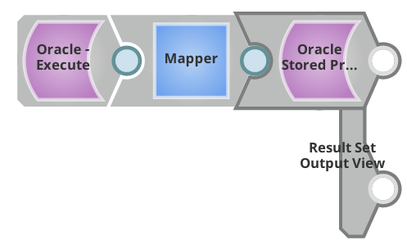
First, we use an Oracle Execute Snap, to get some input data from table TEST_TABLE.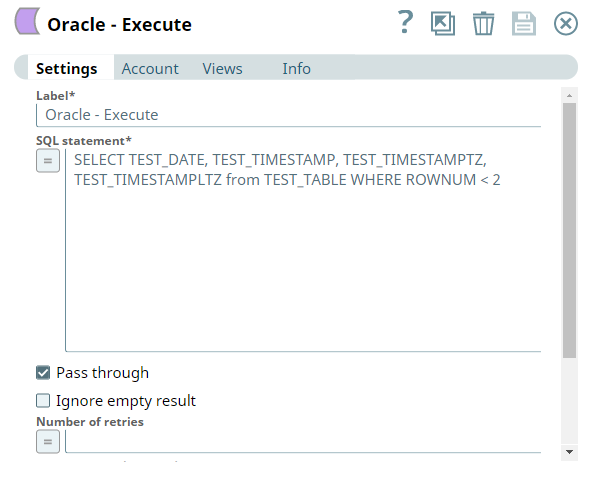
Then, we use a Mapper Snap to map the data from the Oracle - Execute Snap to the Target paths, which the Oracle Stored Procedure Snap uses later.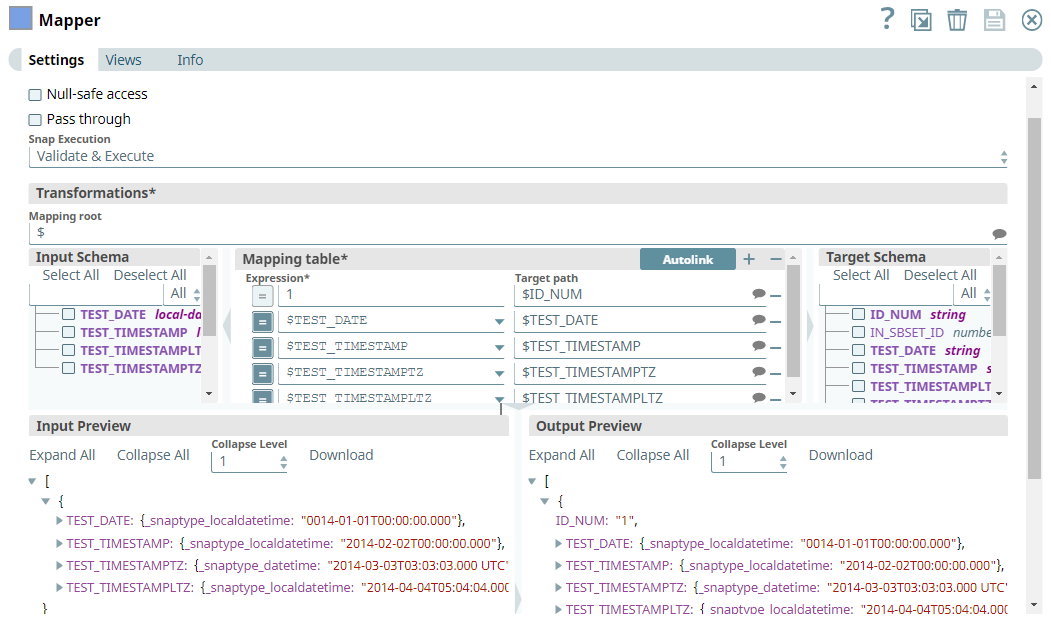
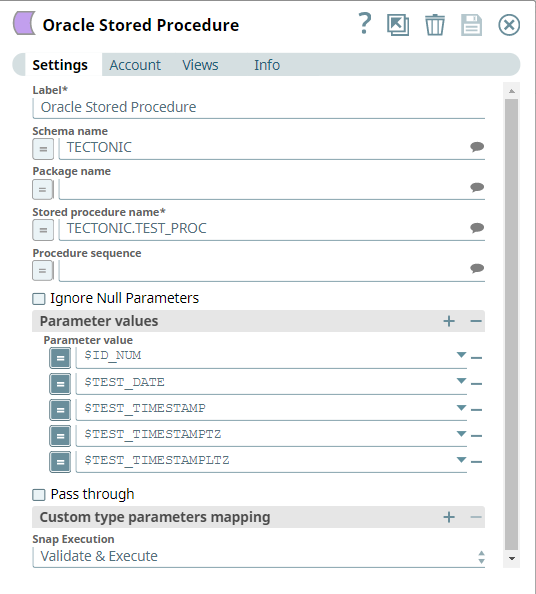
In the Oracle Stored Procedure Snap, we define the stored procedure and parameters.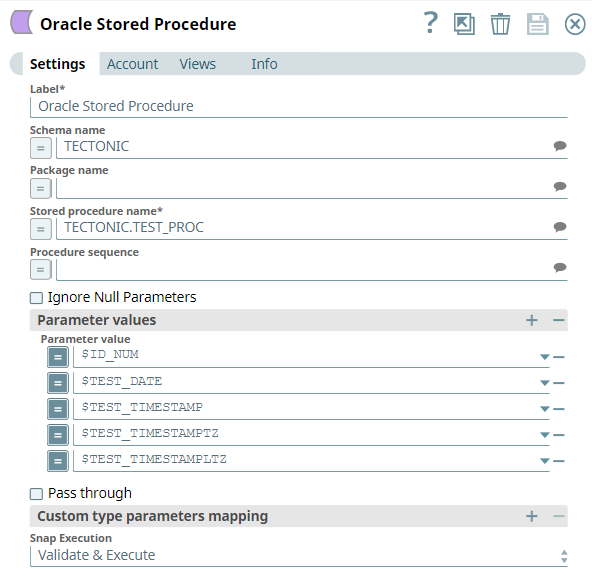
Upon validation, we see the output preview of the Oracle Stored Procedure Snap as shown below: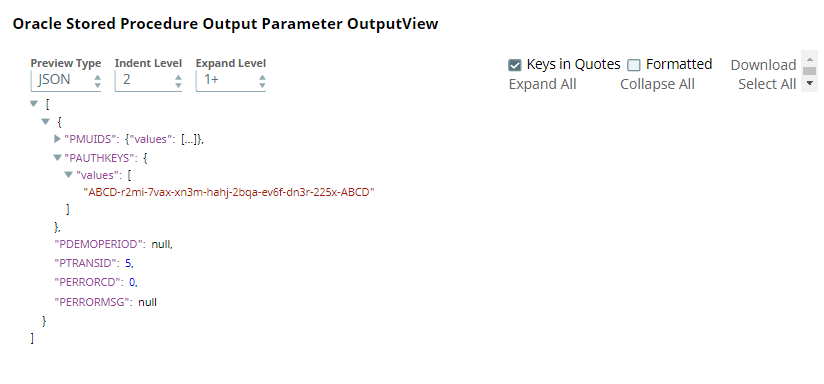
In this example we will call a Oracle Stored Procedure PROC_WITH_CUSTOM_IN_PARAM which has parameters of user-defined types.
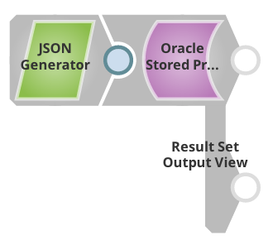
Here is the definition of the stored procedure PROC_WITH_CUSTOM_IN_PARAM:
CREATE OR REPLACE PROCEDURE PROC_WITH_CUSTOM_IN_PARAM
(
    pPairsCount     IN  NUMBER
    ,pPrefix        IN  VARCHAR2
    ,pINMUIDS       IN  STRARRAY32
    ,pMUIDs         OUT STRARRAY32
    ,pAuthKeys      OUT STRARRAY49
    ,pDemoPeriod    OUT NUMBER
    ,pTransID       OUT NUMBER
    ,pErrorCd       OUT NUMBER
    ,pErrorMsg      OUT VARCHAR2
)

AS BEGIN
    select COUNT('s') Into pTransID from ACTRESS a;
    pMUIDs := STRARRAY32();
    pMUIDs.EXTEND(1);
    pAuthKeys := STRARRAY49();
    pAuthKeys.EXTEND(1);
    pMUIDs(1) := inMUIDS(1);
    pAuthKeys(1) := 'ABCD-r2mi-7vax-xn3m-hahj-2bqa-ev6f-dn3r-225x-ABCD';
    pErrorCd := 0;

    EXCEPTION
    WHEN OTHERS THEN
        pErrorCd := 1;
        pErrorMsg := 'Some Error Happened.';

END PROC_WITH_CUSTOM_IN_PARAM;
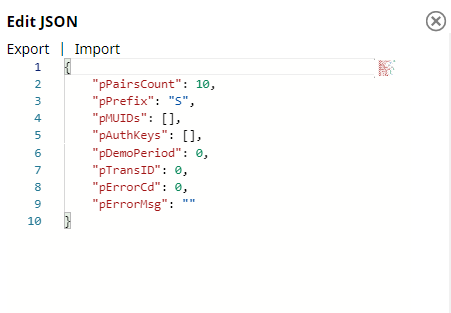
First we use a JSON Generator Snap to pass parameter values as shown below to the Stored Procedure Snap:
Then we use the Stored Procedure Snap procedure name and define parameter values. As there are several parameters that are user-defined types, we add custom type mapping for them. Each mapping row consists of parameter index and type. Parameter index is the index when it is defined, and the parameter type is the name of the user-defined type. You can also use the Suggest button to get the list of available indices or types and select the needed one.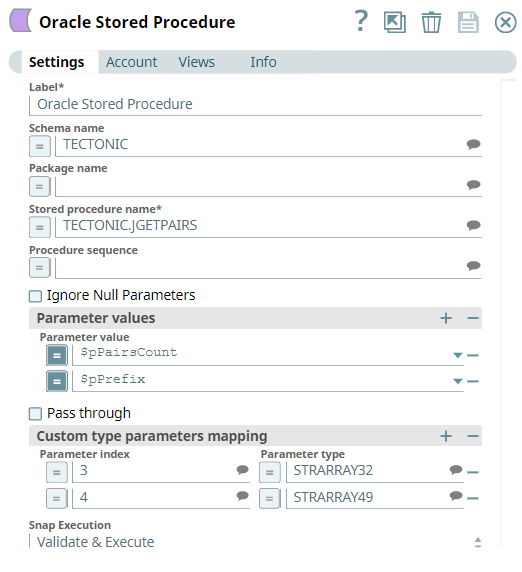
Upon validation, we see the output preview of the Oracle - Stored Procedure Snap as shown below: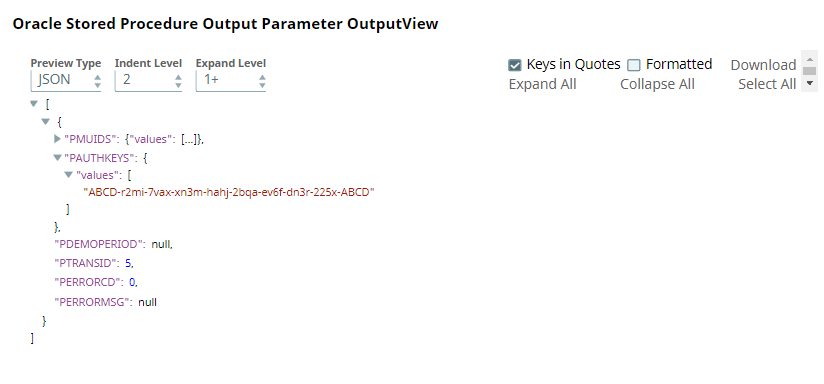
This Pipeline demonstrates invoking a stored function using the Oracle Stored Procedure Snap by defining a custom type mapping and documenting the indexing behavior. The return value has index 1 and the first parameter has index 2.
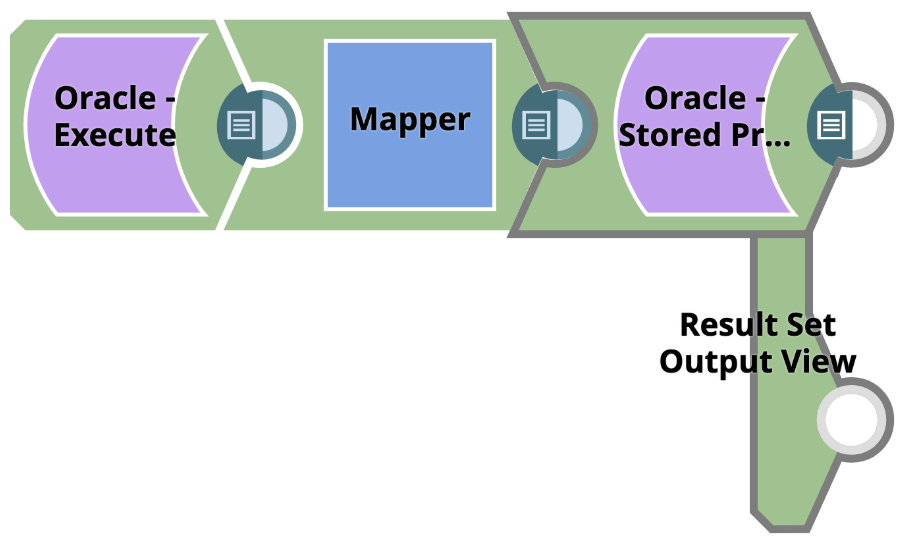
The code in the following section defines the stored function - payroll_pkg.employee_info.
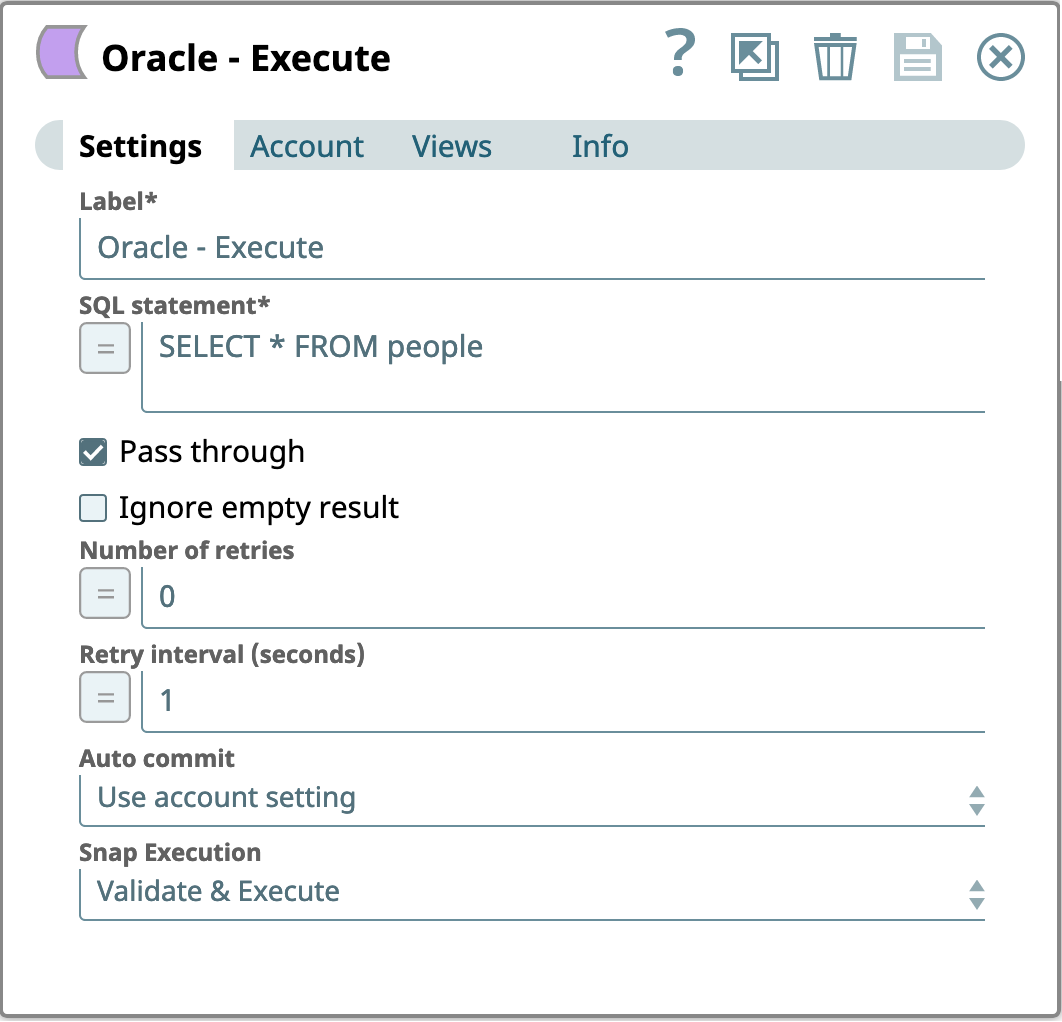
We use the Oracle Execute Snap to query people table.
Then, we use the Mapper Snap to map Employee ID and Full name.
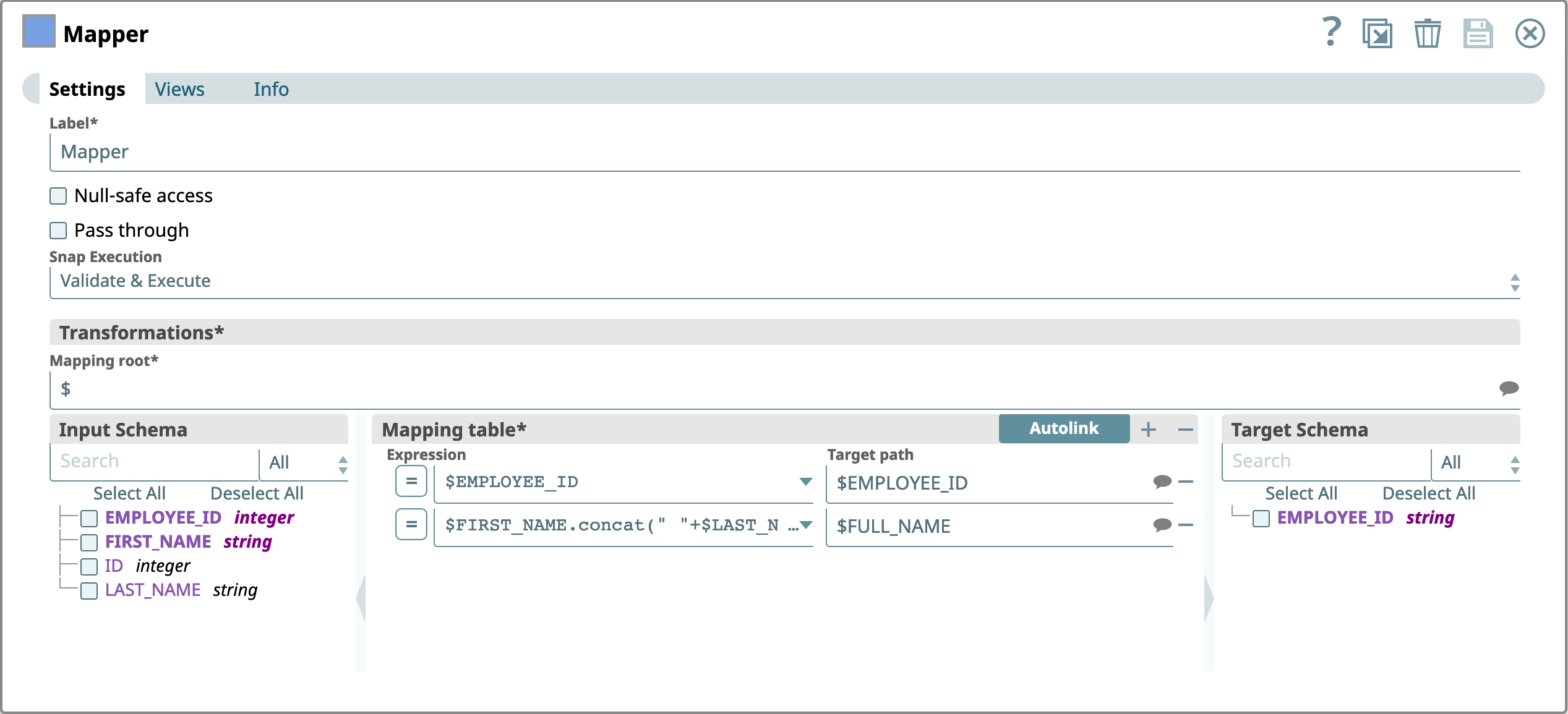
We use the Oracle - Stored Procedure Snap and select the stored procedure.
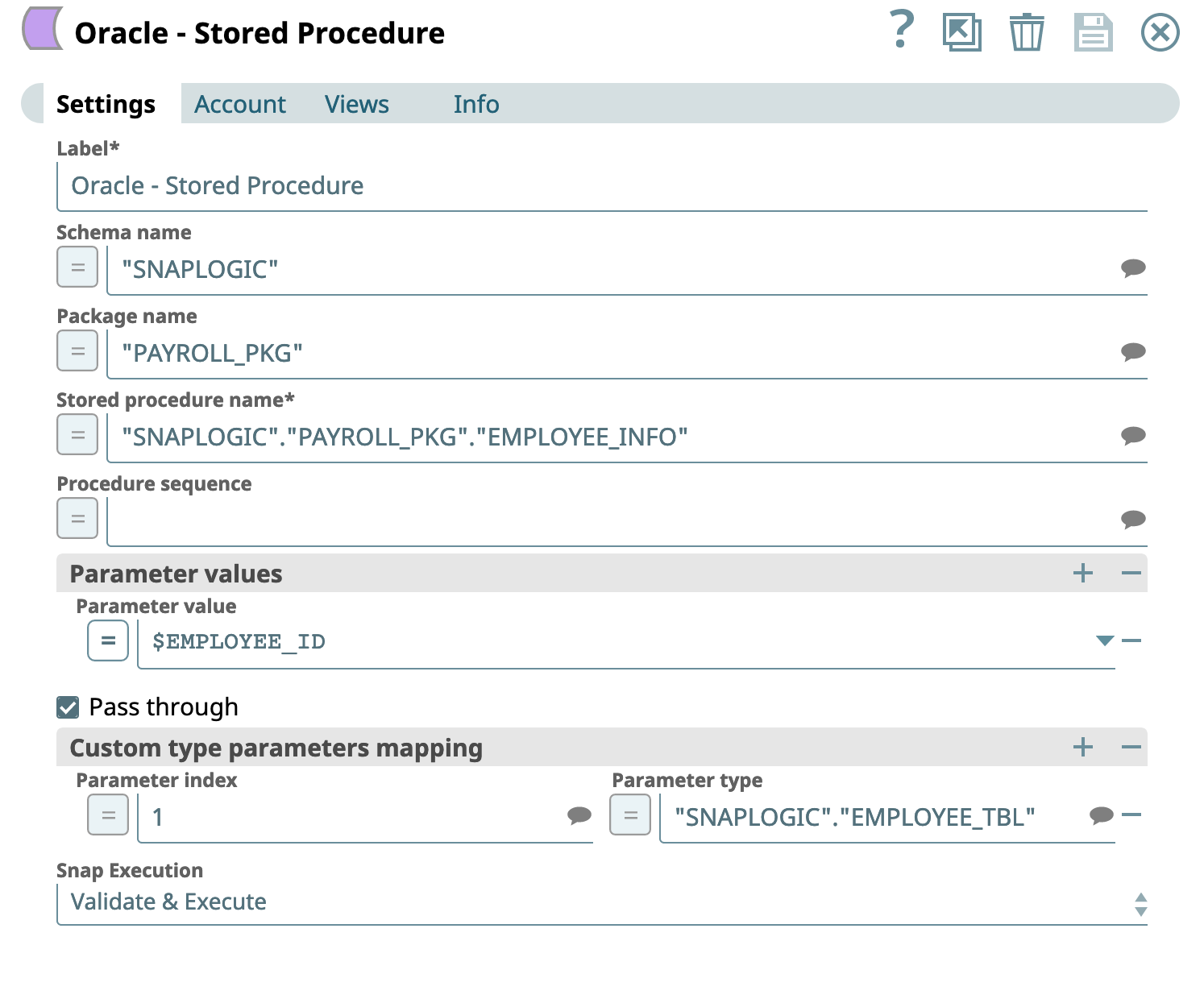
The Oracle Stored Procedure Snap invokes a stored function to lookup employee information, such as the employee's salary and hire date. The function accepts an Employee ID and returns a table of custom types (employee).
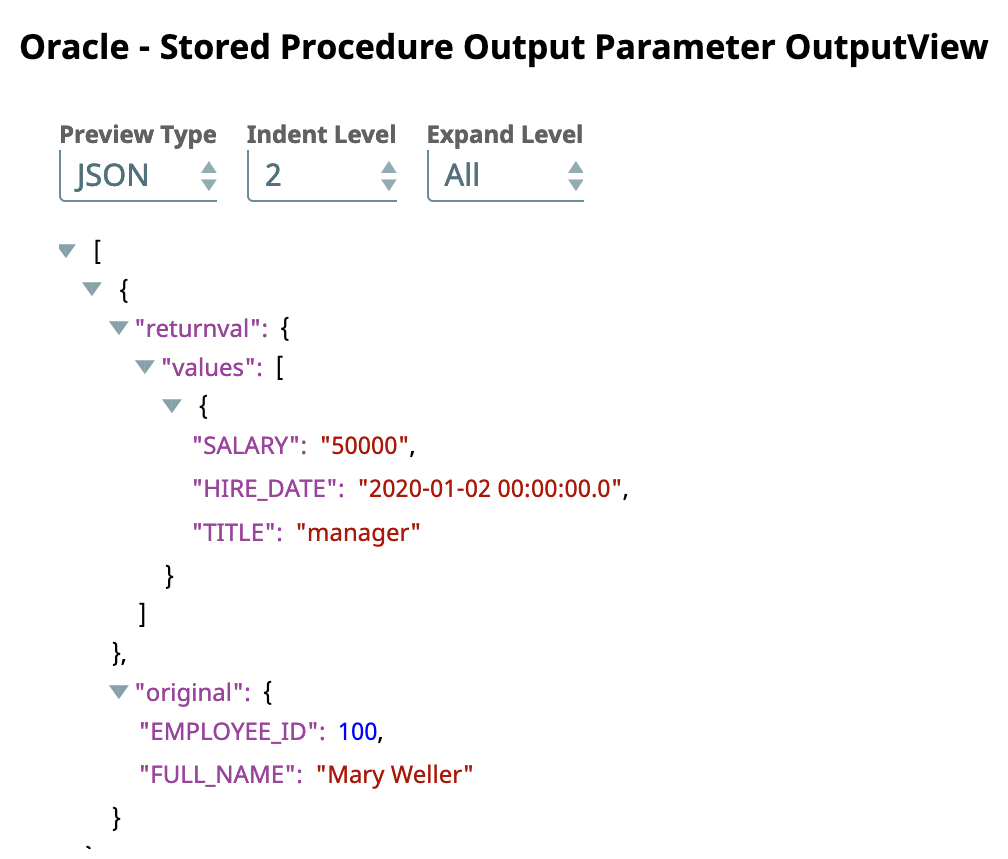
Downloads
| Release | Snap Pack Version | Date | Type | Updates |
|---|---|---|---|---|
May 2025 | main31019 |
| Stable | Updated and certified against the current SnapLogic Platform release. |
| February 2025 | 440patches30071 | Latest | Fixed the Null Pointer Exception (NPE) issue in the Oracle Snaps. Now, these Snaps display an exception error instead of NPE when the URL properties (key and value) and either key or value are empty. | |
| February 2025 | main29887 | Stable | Updated and certified against the current SnapLogic Platform release. | |
| November 2024 | 439patches29008 | Latest | Fixed an issue with Oracle Execute, Select, and Stored Procedure Snaps where the data was displayed in an unexpected structure and without the actual row address value when querying table columns of | |
| November 2024 | main29029 | Stable | Updated and certified against the current SnapLogic Platform release. | |
| August 2024 | 438patches27870 | Latest | Fixed an issue with the Oracle - Merge Snap that caused a date format error when the merge condition was used with the TO_DATE() function. | |
| August 2024 | main27765 | Stable |
| |
| May 2024 | 437patches26651 | Latest |
| |
| May 2024 | 437patches26346 | Latest | Fixed an issue with the Oracle - Execute Snap that displayed an error when handling | |
| May 2024 | main26341 | Stable | Updated the Delete Condition (Truncates a Table if empty) field in the Oracle - Delete Snap to Delete condition (deletes all records from a table if left blank) to indicate that all entries will be deleted from the table when this field is blank, but no truncate operation is performed. | |
| February 2024 | 436patches26208 | Latest | Fixed an issue with Oracle - Bulk Load Snap that intermittently displayed a | |
| February 2024 | 436patches25696 | Latest |
Behavior Change: As part of | |
| February 2024 | main25112 | Stable | Updated and certified against the current SnapLogic Platform release. | |
| November 2023 | 435patches24769 | Latest | Fixed an issue with the Oracle Snap Pack that required the i18n extensions to be present when the Oracle database instance was in a specific language. | |
| November 2023 | 435patches24445 | Latest |
| |
| November 2023 | 435patches23823 | Latest |
| |
| November 2023 | main23721 |
| Stable | Updated and certified against the current SnapLogic Platform release. |
| August 2023 | 434patches23000 | Latest | The JDBC driver for the Oracle Snap Pack is upgraded from OJDBC6 JAR (v11.2.0.4) to OJDBC10 JAR (v19.20.0.0) in the latest distribution in October 2023 and will be deployed to the stable distribution in the November 2023 release (after the Snaplex upgrade). This upgrade changes specific error codes and status messages. The latest JDBC driver upgrade is backward-compatible. Learn more: Upgrading from Oracle JDBC 11.2.0.4 Driver to 19.20.0.0 Driver. | |
| August 2023 | 434patches22787 | Latest | Fixed an issue with the Oracle-Bulk Load Snap that was not resilient to the errors previously when trying to auto-discover the existing SQLLDR utility paths in the node. The Snap is now robust to those errors. | |
August 2023 | main22460 | | Stable | The Oracle - Execute Snap now includes a new Query type field. When Auto is selected, the Snap tries to determine the query type automatically. |
May 2023 | main21015 | Stable | Upgraded with the latest SnapLogic Platform release. | |
| February 2023 | main19844 | Stable | Upgraded with the latest SnapLogic Platform release. | |
November 2022 | 431patches19781 | Latest | The Oracle-Stored Procedure Snap works as expected and does not fail with the error | |
November 2022 | 431patches19275 | Latest | The Oracle - Stored Procedure Snap now supports stored functions with OUT and INOUT parameters and displays these parameter values in the output along with the | |
| November 2022 | main18944 | Stable | The Oracle Insert Snap now creates the target table only from the table metadata of the second input view when the following conditions are met:
| |
| September 2022 | 430patches17894 | Latest | The Oracle Select Snap now work as expected when the table name is dependent on an upstream input. | |
| August 2022 | 430patches17658 | Latest | The Oracle - Stored Procedure Snap now takes lesser time to execute when calling a stored procedure, because the Snap queries the metadata as required, thereby optimizing the Snap's performance. | |
| August 2022 | main17386 | Stable |
| |
| 4.29 Patch | 429patches16603 | Latest |
| |
4.29 | main15993 |
| Stable | Upgraded with the latest SnapLogic Platform release. |
| 4.28 | main14627 | Stable |
| |
| 4.27 | main12833 | Stable |
| |
| 4.26 | main11181 | Stable | Upgraded with the latest SnapLogic Platform release. | |
| 4.25 | 425patches11008 | Latest |
| |
| 4.25 | main9554 | Stable | Upgraded with the latest SnapLogic Platform release. | |
| 4.24 | main8556 | Stable |
| |
| 4.23 | main7430 | Stable | Upgraded with the latest SnapLogic Platform release. | |
| 4.22 | main6403 | Stable | Upgraded with the latest SnapLogic Platform release. | |
| 4.21 Patch | 421patches6272 | Latest | Fixes the issue where Snowflake SCD2 Snap generates two output documents despite no changes to Cause-historization fields with DATE, TIME and TIMESTAMP Snowflake data types, and with Ignore unchanged rows field selected. | |
| 4.21 Patch | 421patches6144 | Latest | Fixes the following issues with DB Snaps:
| |
| 4.21 Patch | MULTIPLE8841 | Latest | Fixes the connection issue in Database Snaps by detecting and closing open connections after the Snap execution ends. | |
| 4.21 | snapsmrc542 |
| Stable | Updated the Oracle Thin Account and Oracle Thin Dynamic Account, enabling them to connect via Oracle Active Data Guard (ADG). |
4.20 Patch | db/oracle8812 | Latest | Enhances the Oracle Snap Pack to support connections to the Oracle ADG (Active Data Guard) URL. | |
4.20 Patch | db/oracle8803 | Latest | Support for Oracle Database 19c. | |
| 4.20 | snapsmrc535 | Stable | Upgraded with the latest SnapLogic Platform release. | |
| 4.19 Patch | db/oracle8408 | Latest | Fixes an issue with the Oracle - Update Snap wherein the Snap is unable to perform operations when:
| |
| 4.19 | snaprsmrc528 | Stable | Upgraded with the latest SnapLogic Platform release. | |
| 4.18 Patch | oracle7786 | Latest | Fixes an issue using the NVARCHAR2 datatype in Oracle databases when the character set is not AL32UTF8. However, a known issue is that special characters display as | |
| 4.18 | snapsmrc523 | Stable | Upgraded with the latest SnapLogic Platform release. | |
| 4.17 Patch | db/oracle7459 | Latest | Fixed an issue with the Oracle Stored Procedure Snap wherein the Pipeline execution fails with an error when the input data type is CLOB. | |
| 4.17 | ALL7402 | Latest | Pushed automatic rebuild of the latest version of each Snap Pack to SnapLogic UAT and Elastic servers. | |
| 4.17 | snapsmrc515 | Latest |
| |
4.16 Patch | db/oracle6919 | Latest | Added a new property, Session parameters, in the Oracle Insert Snap to enable the use of National Language Support (NLS) parameters. | |
4.16 Patch | db/oracle6824 | Latest | Fixed an issue with the Lookup Snap passing data simultaneously to output and error views when some values contained spaces at the end. | |
| 4.16 | snapsmrc508 | Stable | Upgraded with the latest SnapLogic Platform release. | |
| 4.15 Patch | db/oracle6534 | Latest | Improved performance in Pipelines that contain child Pipelines. | |
| 4.15 Patch | db/oracle6417 | Latest | Fixed an issue with data types conversion. All fields with byte, short, int, or long data types will be converted to BigInteger after fetching. | |
| 4.15 Patch | db/oracle6284 | Latest | Replaced the existing Max idle time and Idle connection test period properties with Max life time and Idle Timeout properties respectively, in the Account configuration. The new properties fix the connection release issues that were occurring due to default/restricted DB Account settings. | |
| 4.15 | snapsmrc500 | Stable | Upgraded with the latest SnapLogic Platform release. | |
| 4.14 | snapsmrc490 | Stable | Upgraded with the latest SnapLogic Platform release. | |
4.13 Patch | db/oracle5192 | Latest |
| |
| 4.13 | snapsmrc486 | Stable | Upgraded with the latest SnapLogic Platform release. | |
| 4.12 Patch | oracle4862 | Latest | Fixed an issue in the Oracle Bulk Load Snap that fails to execute the SQLLDR (SQL Loader) command, while also enhancing the support for the TCPS protocol. | |
| 4.12 Patch | db/oracle4721 | Latest | Added a property, "SSL/TCPS" for Oracle Account. | |
| 4.12 Patch | MULTIPLE4744 | Latest | Enabled expression for Delete Condition in Oracle Delete Snap. | |
| 4.12 | snapsmrc480 | Stable | Upgraded with the latest SnapLogic Platform release. | |
4.11 Patch | db/oracle4369 | Latest | Enhanced the Oracle Bulk Load Snap to accept date-type values in the format "yyyy-mm-dd". | |
| 4.11 | snapsmrc465 | Stable | Upgraded with the latest SnapLogic Platform release. | |
| 4.10 Patch | oracle3633 | Latest | Fixed BULK LOAD so it adds the thread name to the name of the temporary directory. This allows multiple BULK LOAD Snaps within a single pipeline. | |
| 4.10 | snapsmrc414 | Stable | Added Auto commit property to the Select and Execute Snaps at the Snap level to support overriding of the Auto commit property at the Account level. | |
4.9.0 Patch | oracle3188 | Latest | Fixed the issue that "NaN" check was done to unexpected data types like varchar. | |
4.9.0 Patch | oracle3096 | Latest | Fixed a class casting issue for custom data types(BLOB, CLOB, NCLOB, etc) when custom Oracle JDBC driver is used. | |
4.9.0 Patch | oracle3071 | Latest | Fixed an issue regarding connection not closed after login failure; Expose autocommit for "Select into" statement in PostgreSQL Execute Snap and Redshift Execute Snap. | |
| 4.9 | snapsmrc405 | Stable | Upgraded with the latest SnapLogic Platform release. | |
4.8.0 Patch | oracle2905 |
| Latest | Fix for SQL*Loader interpreting white-space only data as null values. |
4.8.0 Patch | oracle2756 | Latest | Potential fix for JDBC deadlock issue. | |
4.8.0 Patch | oracle2711 | Latest | Fixed Oracle Snap Pack rendering dates that are one hour off from the date returned by database query for non-UTC Snaplexes. | |
| 4.8 | snapsmrc398 | Stable | Database accounts now invalidate connection pools if account properties are modified and login attempts fail. | |
4.7.0 Patch | oracle2190 | Latest | Fixed an issue with the Oracle Select Snap regarding Limit rows not supporting an empty string from a pipeline parameter. | |
| 4.7 | snapsmrc382 | Stable |
| |
| 4.6 | snapsmrc362 | Stable |
| |
| 4.5.1 | oracle1583 | Stable |
| |
| 4.4.1 | NA | Stable |
| |
| 4.4 | NA | Stable |
| |
| 4.3.2 | NA | Stable |
| |
| NA | NA | Stable |
| |
| NA | NA | Stable |
| |
| NA | NA | Stable |
|
 .
.Have feedback? Email documentation@snaplogic.com | Ask a question in the SnapLogic Community
© 2017-2025 SnapLogic, Inc.