Oracle - Execute
- Kalpana Malladi
- Aparna Tayi (Unlicensed)
- Mohammed Iqbal
In this article
Overview
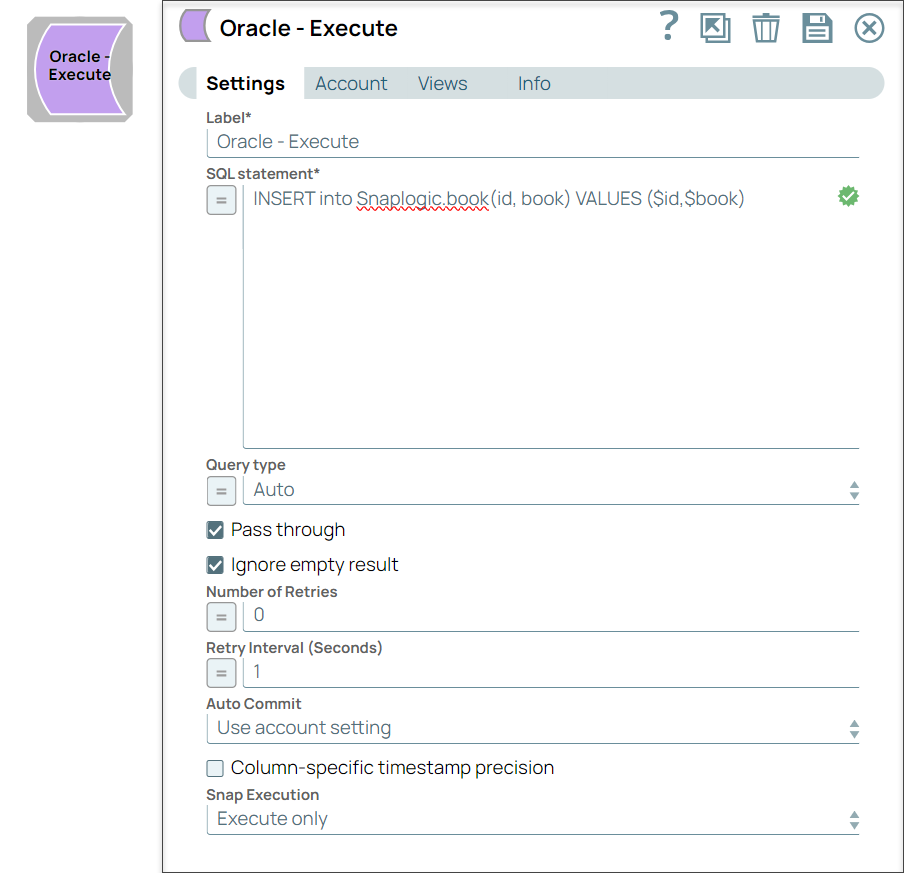
You can use this Snap to execute an Oracle statement or query. This is a Write Snap type. This Snap works only with single queries.
This Snap:
- is for simple DML (SELECT, INSERT, UPDATE, DELETE) type statements. For the comprehensive scripting functionality offered by various databases, use stored procedure functionality offered by their chosen database using the Stored Procedure Snap.
- might drop your database, hence be cautious.
- If you execute a SELECT query, the query's results are merged into the incoming document and the values of any existing keys will be overwritten. On the other hand, if there are no results from the query, the original document is written.
- Any valid JSON paths that you define in the WHERE clause for queries/statements are substituted with values from an incoming document. Documents will be written to the error view if the document is missing a value to be substituted into the query/statement.
Upcoming
Prerequisites
None.
Support for Ultra Pipelines
Works in Ultra Pipelines.
Limitations
- Due to the limitation in Oracle JDBC driver, the SQL statement cannot have semicolons at the end except that it is a BEGIN-END block.
- This Snap cannot invoke procedures, hence we recommend that you use Oracle Stored Procedure Snap for invoking procedures.
Known Issues
When the SQL statement property is an expression, the Pipeline parameters are shown in the Suggest, but not the input schema.
Behavior Change
In 4.26, when the stored procedures were called using the Database Execute Snaps, the queries were treated as write queries instead of read queries. So the output displayed message and status keys after executing the stored procedure.
In 4.27, all the Database Execute Snaps run stored procedures correctly, that is, the queries are treated as read queries. The output now displays message key, and OUT params of the procedure (if any). The status key is not displayed.If the stored procedure has no OUT parameters then only the message key is displayed with value success.
If you have any existing Pipelines that are mapped with status key or previous description then those Pipelines will fail. So, you might need to revisit your Pipeline design.
- Earlier, the
ROWIDcolumns were displayed in binary (Base64 encoded data) form in the output. With the439patches29008, the Oracle Execute and Select Snaps display theROWIDcolumns in string form in the output (which can be used for other operations downstream). - As part of
main23721(because of the JOOQ upgrade) previously, when you used a stored procedure in the Oracle-Execute Snap, the Snap displayed aMessage:Successin the output. Now, the Snap displays$UPDATE_COUNT=-1. As part of
436patches25696, when you use a stored procedure in the Oracle - Execute Snap, the Snap displaysMessage: Successand$UPDATE_COUNT=-1, 0, or 1(based on the Snap Pack behavior) in the output.
Snap Input and Output
| Input/Output | Type of view | Number of views | Examples of Upstream/Downstream Snap | Description |
|---|---|---|---|---|
| Input | Document |
|
| This Snap has at most one document input view. If the input view is defined, then the where clause can substitute incoming values for a given expression. |
| Output | Document |
|
| This Snap has at most one document output view. If an output view is available and an update/insert/merge/delete statement was executed, then the original document that was used to create the statement will be output with the status of the statement executed. Database Write Snaps output all records of a batch (as configured in your account settings) to the error view if the write fails during batch processing. |
Snap Settings
| Field | Field Type | Description | ||||||||||
|---|---|---|---|---|---|---|---|---|---|---|---|---|
Label* | String | Enter a unique name for the Snap. You can modify this to be more specific, especially if you have more than one of the same Snap in your Pipeline. Default Value: Oracle Execute | ||||||||||
SQL statement* | String | Specify the SQL statement to execute on the server. Executing SQL statements in SnapLogic You must understand the following scenarios to successfully execute your SQL statements: Scenario 1: Executing SQL statements without expressions
Examples:
Additionally, the JSON path is allowed only in the WHERE clause. If the SQL statement starts with SELECT (case-insensitive), the Snap regards it as a select-type query and executes once per input document. If not, it regards it as write-type query and executes in batch mode. If your Oracle table has columns whose names contain a '$' (or any other special character) in it, enclose the column name within quotes, such as: Scenario 2: Executing SQL queries using expressions
Table name and column names must not be provided as bind parameters. Only values can be provided as bind parameters. Examples:
We recommend you to use the Oracle Stored Procedure Snap for invoking procedures as the Oracle Execute Snap has the following limitation while invoking procedures:
Oracle JDBC documentation recommends using Single quotes in values must be escaped Any relational database (RDBMS) treats single quotes ( For example:
Default Value: [None] | ||||||||||
| Query type | Dropdown list/Expression | Select the type of query for your SQL statement (Read or Write). When Auto is selected, the Snap tries to determine the query type automatically. Default Value: Auto | ||||||||||
Pass through | Checkbox | Select this checkbox to pass the input document to the output view under the key ' Default Value: Selected | ||||||||||
Ignore empty result | Checkbox | Select this checkbox to not write any document to the output view when a SELECT operation does not produce any result. Default Value: Not selected | ||||||||||
Auto commit | Dropdown list | Choose one of the options from the list to override the state of the Auto commit on the account. The available options are:
Default Value: Use account setting 'Auto commit' may be enabled for certain use cases if PostgreSQL jdbc driver is used in either Redshift, PostgreSQL or generic JDBC Snap. But the JDBC driver may cause out of memory issues when Select statements are executed. In those cases, “Auto commit" in Snap property should be set to ‘False’ and the Fetch size in the “Account setting" can be increased for optimal performance. Behavior of DML Queries in Database Execute Snap when auto-commit is false DDL queries used in the Database Execute Snap will be committed by the Database itself, regardless of the Auto-commit setting. When Auto commit is set to false for the DML queries, commit will be called only at the end of the pipeline lifecycle. Instead of building multiple Snaps with inter dependent DML queries, we recommend you to use the Oracle - Stored Procedure Snap. The Auto commit needs to be true in a scenario where the downstream Snap does depend on the data processed on an Upstream Database Execute Snap containing a DML query. When the Auto commit is set to the Use account setting on the Snap, the account level commit needs to be enabled. | ||||||||||
| Number of retries | Integer | Specify the maximum number of retry attempts the Snap must make in case there is a network failure and is unable to read the target file. The request is terminated if the attempts do not result in a response.
Ensure that the local drive has sufficient free disk space to store the temporary local file. Default Value: 0 | ||||||||||
| Retry interval (seconds) | Integer | Specify the time interval between two successive retry requests. A retry happens only when the previous attempt resulted in an exception. Default Value: 1 | ||||||||||
| Column-specific timestamp precision | Checkbox | Select this checkbox to display the timestamp with millisecond/microsecond/nanosecond precision in string type. By default, the checkbox is deselected, which maintains the backward compatibility (supports only millisecond of date time type). Default Value: Deselected | ||||||||||
Snap Execution | Dropdown list | Select one of the three modes in which the Snap executes. Available options are:
| ||||||||||
.png?version=1&modificationDate=1489898974637&cacheVersion=1&api=v2)
.png?version=1&modificationDate=1489898972602&cacheVersion=1&api=v2)
Examples
In this example, we have a table named STUDENT that stores students' scores. It has 3 columns: ID, NAME and SCORE. We will get the record of a student named "Brace" with this pipeline:

The JSON Generator Snap passes the student's name to Oracle-Execute Snap: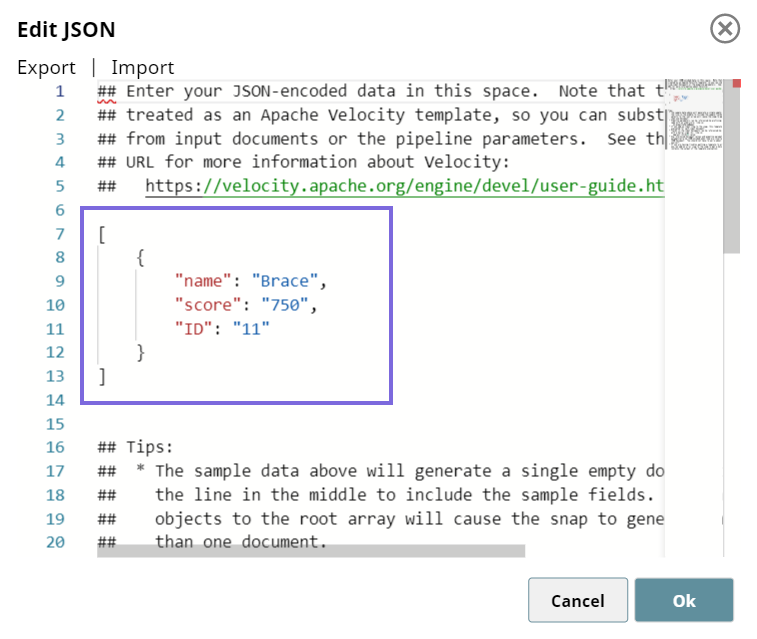
The Oracle-Execute Snap executes a select SQL statement to get the student's information from table STUDENT. Note that the student's name passed from previous Snap can be accessed with "$name".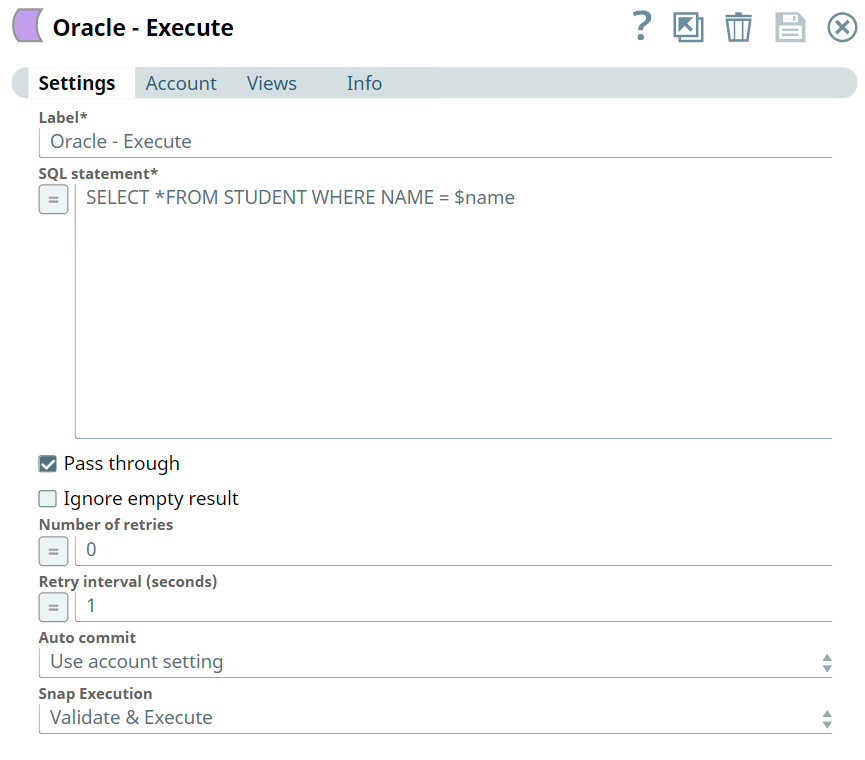
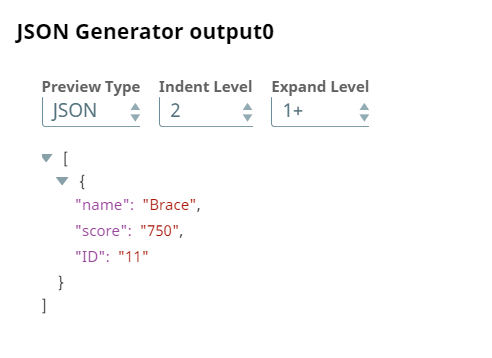
Here is the running result of the pipeline:
This example will show the error handling of the Snap.
We use the same pipeline as the one in example #1 and route error messages to error view:
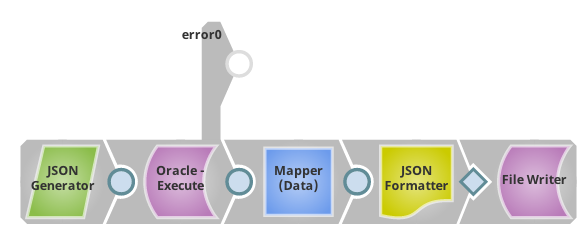
The Oracle - Execute Snap tries to select AGE column that doesn't exist in table STUDENT. This should cause a SQL execution error and the error message will be routed to error view:
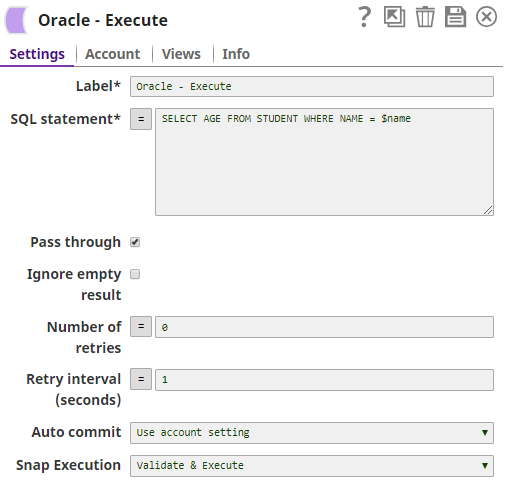
Here is the error message that is routed to the error view:

Downloads
Important steps to successfully reuse Pipelines
- Download and import the pipeline into the SnapLogic application.
- Configure Snap accounts as applicable.
- Provide pipeline parameters as applicable.
Snap Pack History
| Release | Snap Pack Version | Date | Type | Updates |
|---|---|---|---|---|
| February 2025 | 440patches30071 | Latest | Fixed the Null Pointer Exception (NPE) issue in the Oracle Snaps. Now, these Snaps display an exception error instead of NPE when the URL properties (key and value) and either key or value are empty. | |
| February 2025 | main29887 | Stable | Updated and certified against the current SnapLogic Platform release. | |
| November 2024 | 439patches29008 | Latest | Fixed an issue with Oracle Execute, Select, and Stored Procedure Snaps where the data was displayed in an unexpected structure and without the actual row address value when querying table columns of | |
| November 2024 | main29029 | Stable | Updated and certified against the current SnapLogic Platform release. | |
| August 2024 | 438patches27870 | Latest | Fixed an issue with the Oracle - Merge Snap that caused a date format error when the merge condition was used with the TO_DATE() function. | |
| August 2024 | main27765 | Stable |
| |
| May 2024 | 437patches26651 | Latest |
| |
| May 2024 | 437patches26346 | Latest | Fixed an issue with the Oracle - Execute Snap that displayed an error when handling | |
| May 2024 | main26341 | Stable | Updated the Delete Condition (Truncates a Table if empty) field in the Oracle - Delete Snap to Delete condition (deletes all records from a table if left blank) to indicate that all entries will be deleted from the table when this field is blank, but no truncate operation is performed. | |
| February 2024 | 436patches26208 | Latest | Fixed an issue with Oracle - Bulk Load Snap that intermittently displayed a | |
| February 2024 | 436patches25696 | Latest |
Behavior Change: As part of | |
| February 2024 | main25112 | Stable | Updated and certified against the current SnapLogic Platform release. | |
| November 2023 | 435patches24769 | Latest | Fixed an issue with the Oracle Snap Pack that required the i18n extensions to be present when the Oracle database instance was in a specific language. | |
| November 2023 | 435patches24445 | Latest |
| |
| November 2023 | 435patches23823 | Latest |
| |
| November 2023 | main23721 |
| Stable | Updated and certified against the current SnapLogic Platform release. |
| August 2023 | 434patches23000 | Latest | The JDBC driver for the Oracle Snap Pack is upgraded from OJDBC6 JAR (v11.2.0.4) to OJDBC10 JAR (v19.20.0.0) in the latest distribution in October 2023 and will be deployed to the stable distribution in the November 2023 release (after the Snaplex upgrade). This upgrade changes specific error codes and status messages. The latest JDBC driver upgrade is backward-compatible. Learn more: Upgrading from Oracle JDBC 11.2.0.4 Driver to 19.20.0.0 Driver. | |
| August 2023 | 434patches22787 | Latest | Fixed an issue with the Oracle-Bulk Load Snap that was not resilient to the errors previously when trying to auto-discover the existing SQLLDR utility paths in the node. The Snap is now robust to those errors. | |
August 2023 | main22460 | | Stable | The Oracle - Execute Snap now includes a new Query type field. When Auto is selected, the Snap tries to determine the query type automatically. |
May 2023 | main21015 | Stable | Upgraded with the latest SnapLogic Platform release. | |
| February 2023 | main19844 | Stable | Upgraded with the latest SnapLogic Platform release. | |
November 2022 | 431patches19781 | Latest | The Oracle-Stored Procedure Snap works as expected and does not fail with the error | |
November 2022 | 431patches19275 | Latest | The Oracle - Stored Procedure Snap now supports stored functions with OUT and INOUT parameters and displays these parameter values in the output along with the | |
| November 2022 | main18944 | Stable | The Oracle Insert Snap now creates the target table only from the table metadata of the second input view when the following conditions are met:
| |
| September 2022 | 430patches17894 | Latest | The Oracle Select Snap now work as expected when the table name is dependent on an upstream input. | |
| August 2022 | 430patches17658 | Latest | The Oracle - Stored Procedure Snap now takes lesser time to execute when calling a stored procedure, because the Snap queries the metadata as required, thereby optimizing the Snap's performance. | |
| August 2022 | main17386 | Stable |
| |
| 4.29 Patch | 429patches16603 | Latest |
| |
4.29 | main15993 |
| Stable | Upgraded with the latest SnapLogic Platform release. |
| 4.28 | main14627 | Stable |
| |
| 4.27 | main12833 | Stable |
| |
| 4.26 | main11181 | Stable | Upgraded with the latest SnapLogic Platform release. | |
| 4.25 | 425patches11008 | Latest |
| |
| 4.25 | main9554 | Stable | Upgraded with the latest SnapLogic Platform release. | |
| 4.24 | main8556 | Stable |
| |
| 4.23 | main7430 | Stable | Upgraded with the latest SnapLogic Platform release. | |
| 4.22 | main6403 | Stable | Upgraded with the latest SnapLogic Platform release. | |
| 4.21 Patch | 421patches6272 | Latest | Fixes the issue where Snowflake SCD2 Snap generates two output documents despite no changes to Cause-historization fields with DATE, TIME and TIMESTAMP Snowflake data types, and with Ignore unchanged rows field selected. | |
| 4.21 Patch | 421patches6144 | Latest | Fixes the following issues with DB Snaps:
| |
| 4.21 Patch | MULTIPLE8841 | Latest | Fixes the connection issue in Database Snaps by detecting and closing open connections after the Snap execution ends. | |
| 4.21 | snapsmrc542 |
| Stable | Updated the Oracle Thin Account and Oracle Thin Dynamic Account, enabling them to connect via Oracle Active Data Guard (ADG). |
4.20 Patch | db/oracle8812 | Latest | Enhances the Oracle Snap Pack to support connections to the Oracle ADG (Active Data Guard) URL. | |
4.20 Patch | db/oracle8803 | Latest | Support for Oracle Database 19c. | |
| 4.20 | snapsmrc535 | Stable | Upgraded with the latest SnapLogic Platform release. | |
| 4.19 Patch | db/oracle8408 | Latest | Fixes an issue with the Oracle - Update Snap wherein the Snap is unable to perform operations when:
| |
| 4.19 | snaprsmrc528 | Stable | Upgraded with the latest SnapLogic Platform release. | |
| 4.18 Patch | oracle7786 | Latest | Fixes an issue using the NVARCHAR2 datatype in Oracle databases when the character set is not AL32UTF8. However, a known issue is that special characters display as | |
| 4.18 | snapsmrc523 | Stable | Upgraded with the latest SnapLogic Platform release. | |
| 4.17 Patch | db/oracle7459 | Latest | Fixed an issue with the Oracle Stored Procedure Snap wherein the Pipeline execution fails with an error when the input data type is CLOB. | |
| 4.17 | ALL7402 | Latest | Pushed automatic rebuild of the latest version of each Snap Pack to SnapLogic UAT and Elastic servers. | |
| 4.17 | snapsmrc515 | Latest |
| |
4.16 Patch | db/oracle6919 | Latest | Added a new property, Session parameters, in the Oracle Insert Snap to enable the use of National Language Support (NLS) parameters. | |
4.16 Patch | db/oracle6824 | Latest | Fixed an issue with the Lookup Snap passing data simultaneously to output and error views when some values contained spaces at the end. | |
| 4.16 | snapsmrc508 | Stable | Upgraded with the latest SnapLogic Platform release. | |
| 4.15 Patch | db/oracle6534 | Latest | Improved performance in Pipelines that contain child Pipelines. | |
| 4.15 Patch | db/oracle6417 | Latest | Fixed an issue with data types conversion. All fields with byte, short, int, or long data types will be converted to BigInteger after fetching. | |
| 4.15 Patch | db/oracle6284 | Latest | Replaced the existing Max idle time and Idle connection test period properties with Max life time and Idle Timeout properties respectively, in the Account configuration. The new properties fix the connection release issues that were occurring due to default/restricted DB Account settings. | |
| 4.15 | snapsmrc500 | Stable | Upgraded with the latest SnapLogic Platform release. | |
| 4.14 | snapsmrc490 | Stable | Upgraded with the latest SnapLogic Platform release. | |
4.13 Patch | db/oracle5192 | Latest |
| |
| 4.13 | snapsmrc486 | Stable | Upgraded with the latest SnapLogic Platform release. | |
| 4.12 Patch | oracle4862 | Latest | Fixed an issue in the Oracle Bulk Load Snap that fails to execute the SQLLDR (SQL Loader) command, while also enhancing the support for the TCPS protocol. | |
| 4.12 Patch | db/oracle4721 | Latest | Added a property, "SSL/TCPS" for Oracle Account. | |
| 4.12 Patch | MULTIPLE4744 | Latest | Enabled expression for Delete Condition in Oracle Delete Snap. | |
| 4.12 | snapsmrc480 | Stable | Upgraded with the latest SnapLogic Platform release. | |
4.11 Patch | db/oracle4369 | Latest | Enhanced the Oracle Bulk Load Snap to accept date-type values in the format "yyyy-mm-dd". | |
| 4.11 | snapsmrc465 | Stable | Upgraded with the latest SnapLogic Platform release. | |
| 4.10 Patch | oracle3633 | Latest | Fixed BULK LOAD so it adds the thread name to the name of the temporary directory. This allows multiple BULK LOAD Snaps within a single pipeline. | |
| 4.10 | snapsmrc414 | Stable | Added Auto commit property to the Select and Execute Snaps at the Snap level to support overriding of the Auto commit property at the Account level. | |
4.9.0 Patch | oracle3188 | Latest | Fixed the issue that "NaN" check was done to unexpected data types like varchar. | |
4.9.0 Patch | oracle3096 | Latest | Fixed a class casting issue for custom data types(BLOB, CLOB, NCLOB, etc) when custom Oracle JDBC driver is used. | |
4.9.0 Patch | oracle3071 | Latest | Fixed an issue regarding connection not closed after login failure; Expose autocommit for "Select into" statement in PostgreSQL Execute Snap and Redshift Execute Snap. | |
| 4.9 | snapsmrc405 | Stable | Upgraded with the latest SnapLogic Platform release. | |
4.8.0 Patch | oracle2905 |
| Latest | Fix for SQL*Loader interpreting white-space only data as null values. |
4.8.0 Patch | oracle2756 | Latest | Potential fix for JDBC deadlock issue. | |
4.8.0 Patch | oracle2711 | Latest | Fixed Oracle Snap Pack rendering dates that are one hour off from the date returned by database query for non-UTC Snaplexes. | |
| 4.8 | snapsmrc398 | Stable | Database accounts now invalidate connection pools if account properties are modified and login attempts fail. | |
4.7.0 Patch | oracle2190 | Latest | Fixed an issue with the Oracle Select Snap regarding Limit rows not supporting an empty string from a pipeline parameter. | |
| 4.7 | snapsmrc382 | Stable |
| |
| 4.6 | snapsmrc362 | Stable |
| |
| 4.5.1 | oracle1583 | Stable |
| |
| 4.4.1 | NA | Stable |
| |
| 4.4 | NA | Stable |
| |
| 4.3.2 | NA | Stable |
| |
| NA | NA | Stable |
| |
| NA | NA | Stable |
| |
| NA | NA | Stable |
|
 .
.Have feedback? Email documentation@snaplogic.com | Ask a question in the SnapLogic Community
© 2017-2025 SnapLogic, Inc.