Atlassian uses cookies to improve your browsing experience, perform analytics and research, and conduct advertising. Accept all cookies to indicate that you agree to our use of cookies on your device. Atlassian cookies and tracking notice, (opens new window)
This Snap is used to execute multiple Redshift SQL statements sequentially inside of a single BEGIN and END transaction for each input document. If an SQL statement fails, subsequent SQL statements are not executed and error output goes to the error view (if the corresponding option is selected). If all statements are successful, all output results go to the output view. Data can be written to both output and error view if using multiple input documents. Use this Snap to perform updates to Redshift data that would otherwise be done in a Stored Procedure.
Select statements that return data results, and transaction sql statements such as begin, end, commit and rollback are not supported.
ETL Transformations & Data Flow
This Snap enables the following ETL operations/flows:
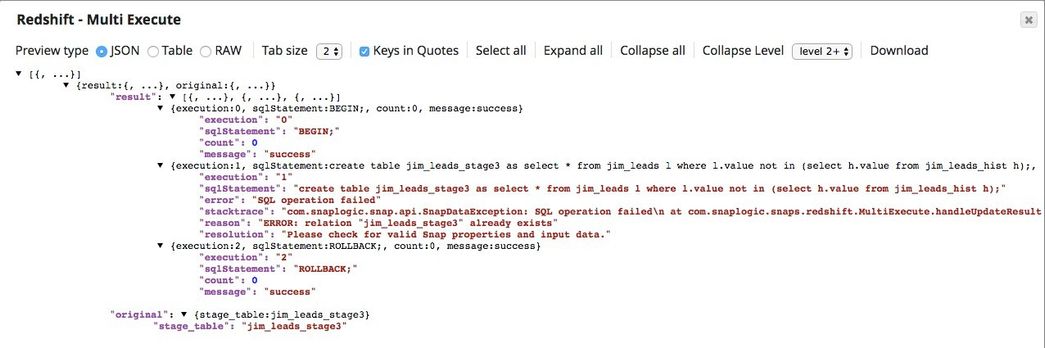
The Snap executes a sequence of multiple Redshift DDL commands in a sequential order as specified in the Executions section and the result will be written to the output view which contains results from individual queries that have been executed from the provided properties. If any submitted query fails, the Snap will throw an exception and rollback changes from prior queries.
Input & Output:
Input: The Snap can have zero to one input document to trigger multi-executions of SQL statements and any necessary field data values if expressions are used in the SQL executions.
Output: The output results will be written to the output view.
Upstream & Downstream Snaps
Expected Upstream Snaps: Upstream Snap is not required - the MultiExecute Snap will execute once if no input view is defined. However, if there is an upstream Snap, it should only produce documents to trigger the MultiExecute Snap. For example, if zero documents are produced by an upstream Snap, the MultiExecute SQL will not execute. If two documents are produced, the MultiExecute will execute twice, once for each input document (the original input document data will be preserved in the output views)
Expected Downstream Snaps:Applicable downstream Snaps to handle the possible Redshift SQL data results emitted on the output and error view can be used.
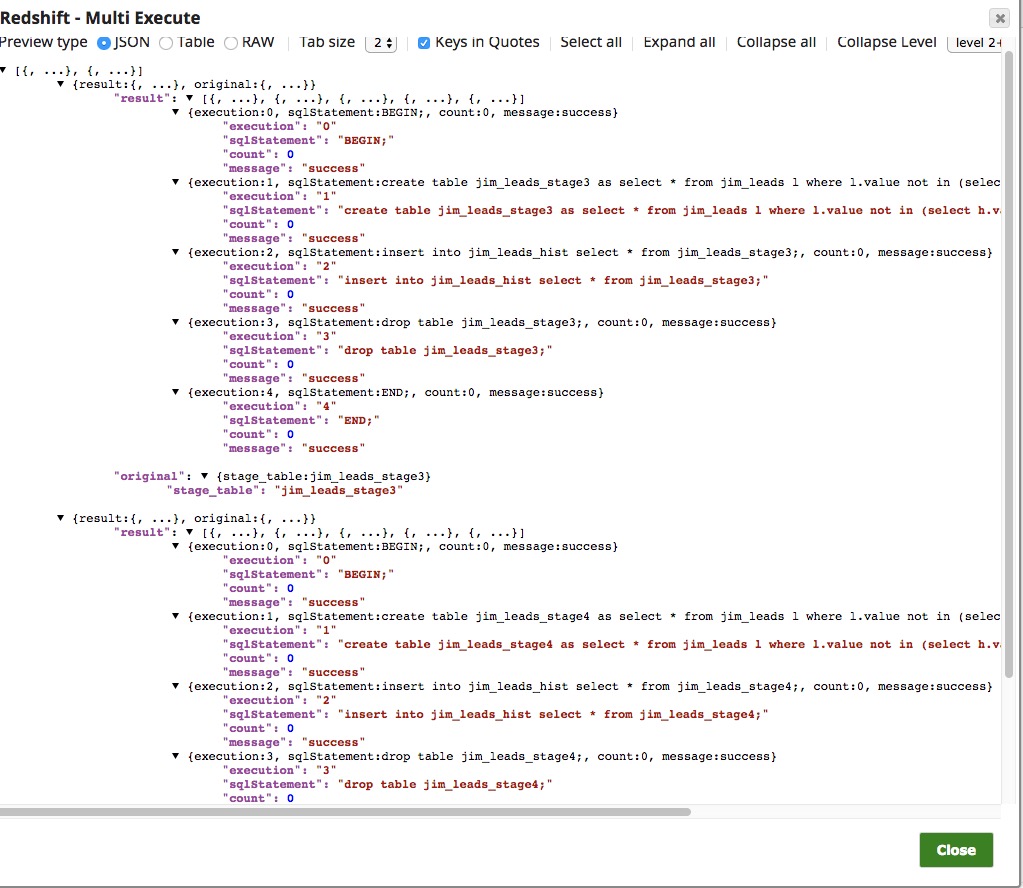
A BEGIN and END statement are prepended and appended, respectively, to the MultiExecute SQL automatically by the Snap. The result of these statements is added to the output and error views.
Does not support transaction, commit, and rollback operations.
Loading
Configurations:
Account & Access
This Snap uses account references created on the Accounts page of SnapLogic Manager to handle access to this endpoint. See Redshift Account for information on setting up this type of account.
Views
Input
This Snap can have at most one input view.
Output
This Snap has at most one output view.
Error
This Snap has at most one error view and produces zero or more documents in the view.
Troubleshooting:
[None]
Settings
Label
Required. The name for the Snap. You can modify this to be more specific, especially if you have more than one of the same Snap in your pipeline.
Executions
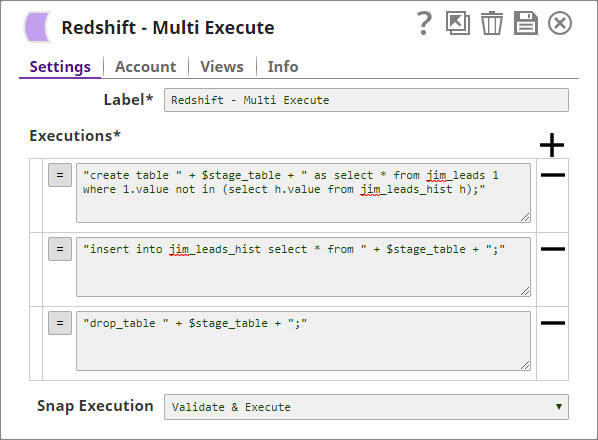
Required. Specifies the SQL statement to execute on the server.
Examples:
Loading
create table stage_table as select * from leads l where l.value not in (select h.value from leads_hist h);
insert into leads_hist select * from stage_table;
drop table stage_table;
Loading
Caution
Using expressions that join strings together to create SQL queries or conditions has a potential SQL injection risk and hence unsafe. Ensure that you understand all implications and risks involved before using concatenation of strings with '=' Expression enabled.
Single quotes in values must be escaped
Any relational database (RDBMS) treats single quotes (') as special symbols. So, single quotes in the data or values passed through a DML query may cause the Snap to fail when the query is executed. Ensure that you pass two consecutive single quotes in place of one within these values to escape the single quote through these queries.
For example:
If String
To pass this value
Use
Has no single quotes
Schaum Series
'Schaum Series'
Contains single quotes
O'Reilly's Publication
'O''Reilly''s Publication'
Default value: [None]
Loading
Loading
Troubleshooting
Error
Reason
Resolution
type "e" does not exist
This issue occurs due to incompatibilities with the recent upgrade in the Postgres JDBC drivers.
Download the latest 4.1 Amazon Redshift driverhereand use this driver in yourRedshift Account configuration and retry running the Pipeline.
Examples
Basic Use Case
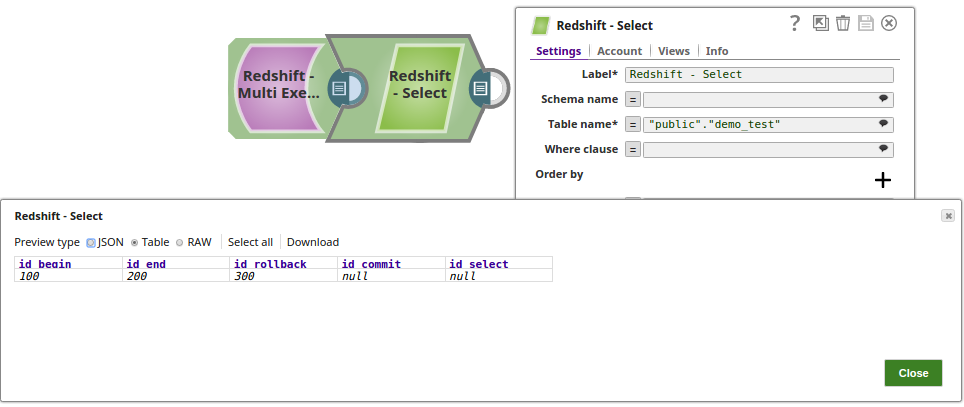
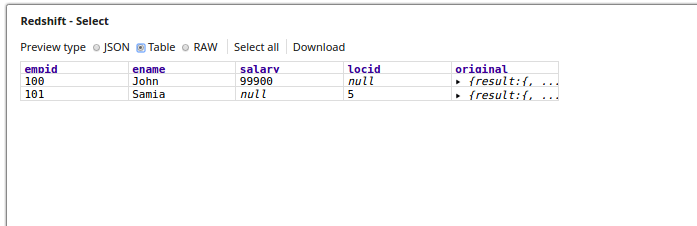
The following pipeline describes how the Snap functions as a standalone Snap in a pipeline (a Select Snap is used here to display the output preview of the records added as displayed in the second image below):
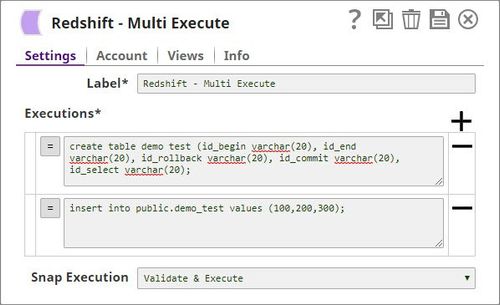
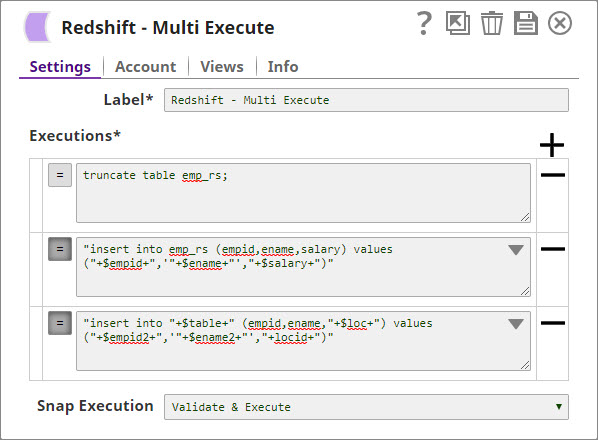
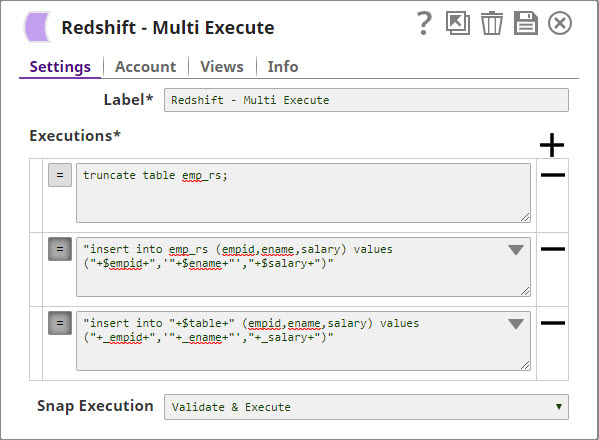
An example of MultiExecute properties, in this case, the SQL is using expressions:
The successful output after two input documents:
The error output preview:
Typical Snap Configurations
The key configuration of the Snap lies in how you pass the SQL statement to execute a function:
Without Expression: Directly passing the required SQL statements in the Redshift Multi Execute Snap. Literal statements (without SQL parameters or SnapLogic expressions):
With SQL parameters:
With Expressions
It is possible to pass values to the Redshift Multi Execute Snap using expression language as well. In the example below, the values are passed using a query from an upstream snap and pipeline parameters. Both these methods are demonstrated in detail below:
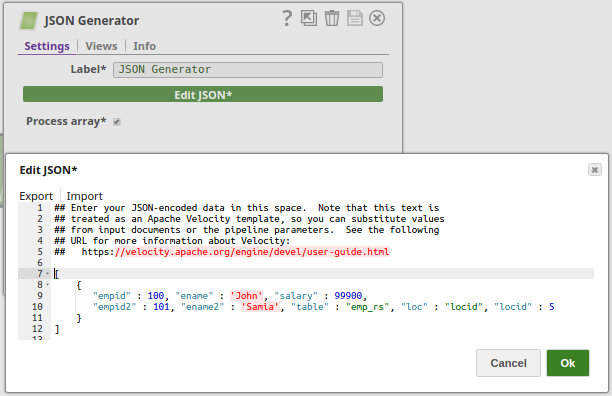
Query from an upstream Snap: The Redshift Multi Execute Snap receives values from the upstream JSON Generator Snap.
The Multi Execute Snap executes the SQL statements as passed using the upstream JSON Generator Snap:
The Redshift Select Snap displays the out preview with the added records:
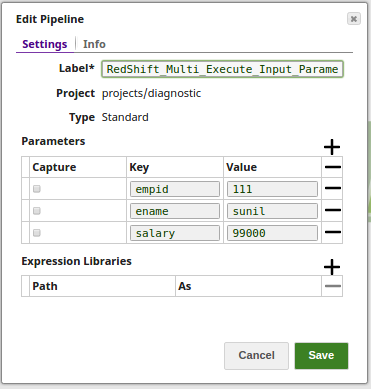
Pipeline Parameter: Pipeline parameter set to pass the required SQL Statement to the Multi Execute Snap.
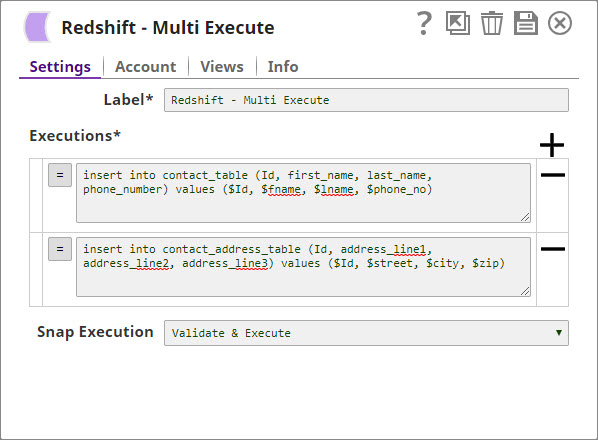
In the below Snap Executions settings, the values for the fields are passed using the pipeline parameters.
Advanced Use Case
The pipeline shows how to execute multiple SQL statements to insert records into the table, emp_RS, using the Redshift Multi Execute Snap. We also use the Redshift Select Snap to read the table to which the records are added. Here, we pass the values using the upstream and also dynamically, by defining the pipeline parameters respectively.
1. Edit the JSON Generator Snap and input the upstream data to be passed into the table, emp_RS.
The output preview from the JSON Generator Snap is as below:
2. Set the pipeline parameters to be passed dynamically:
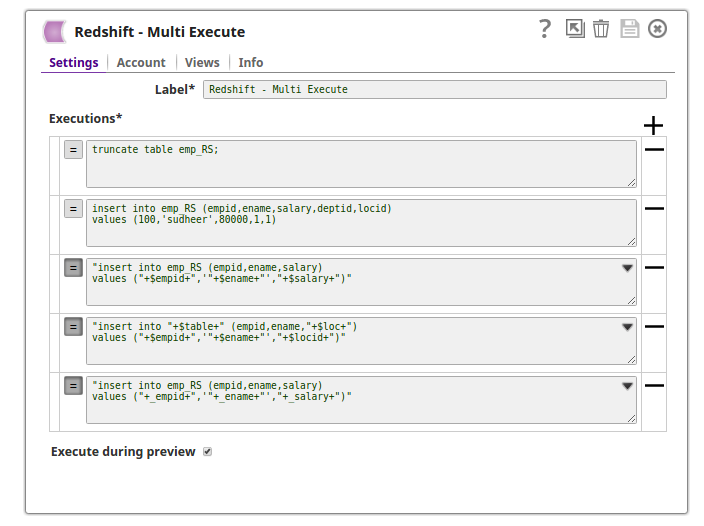
3. In the Redshift - Multi Execute Snap, the SQL statement executions are as below:
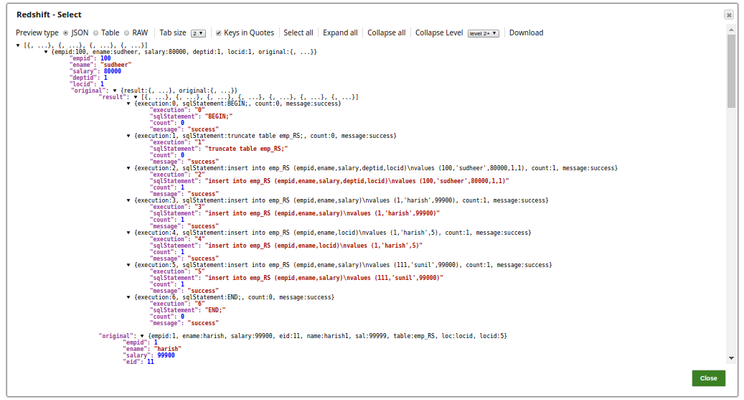
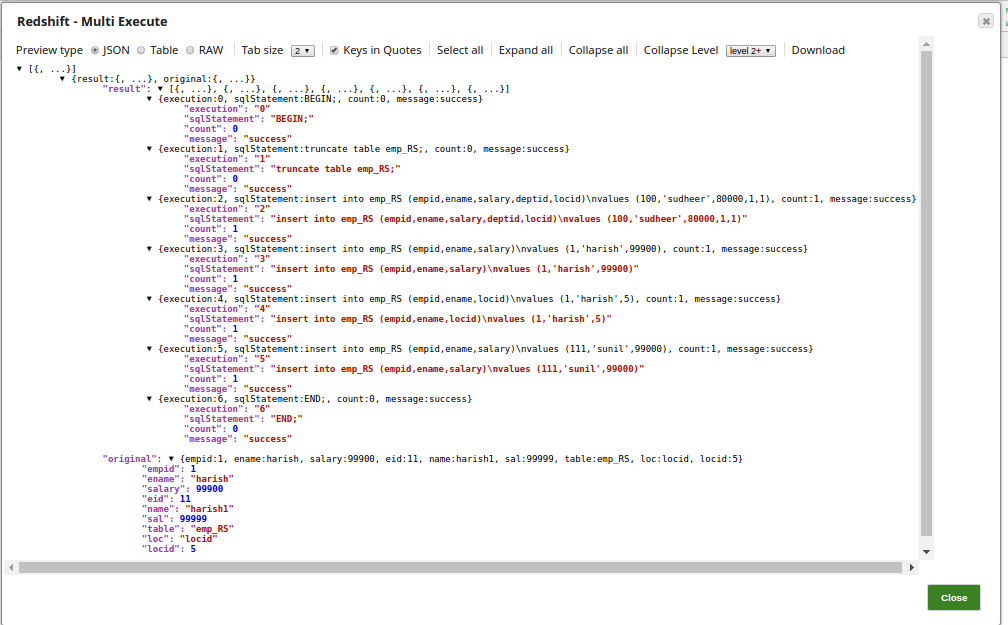
4. The output preview of the Redshift - Multi Execute Snap has the status of the executions (result) displayed sequentially between the 'BEGIN' and the 'END' execution transaction:
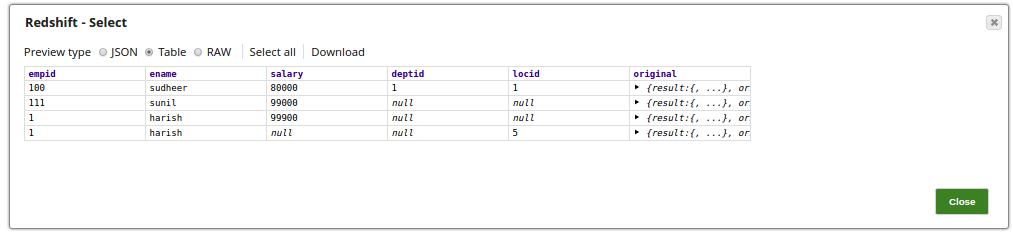
5. View the table "public"."emp_RS" to which we added the records using the Redshift - Select Snap:
6. Successful execution of the pipeline displays the below output preview in a JSON or a Table format respectively:
Updated and certified against the current SnapLogic Platform release.
February 2025
440patches30071
Latest
Fixed the Null Pointer Exception (NPE) issue in the Redshift Snaps. Now, these Snaps display an exception error instead of NPE when the URL properties (key and value) and either key or value are empty.
February 2025
main29887
Stable
Updated and certified against the current SnapLogic Platform release.
November 2024
main29029
Stable
Updated and certified against the current SnapLogic Platform release.
August 2024
main27765
Stable
Upgraded the org.json.json library from v20090211 to v20240303, which is fully backward compatible.
Upgraded the JDBC driver for the Redshift Snap Pack to v2.1.0.29 to address the SQL Injection vulnerabilities. Pipelines using the Redshift Snaps are not impacted after the driver upgrade, because the latest JDBC driver is fully backward compatible.
May 2024
437patches26634
Latest
Fixed an issue withRedshift - Execute Snap that produced logs causing node crashes.
May 2024
main26341
Stable
Updated the Delete Condition (Truncates a Table if empty) field in the Redshift - DeleteSnap to Delete condition (deletes all records from a table if left blank) to indicate that all entries will be deleted from the table when this field is blank, but no truncate operation is performed.
February 2024
main25112
Stable
Updated and certified against the current SnapLogic Platform release.
November 2023
main23721
Stable
Updated and certified against the current SnapLogic Platform release.
August 2023
main22460
Stable
The Redshift-Bulk Load and Redshift-Bulk Upsert Snaps now support expression enablers for the Additional options field that enables you to use parameters.
The Redshift - Execute Snap now includes a new Query type field. When Auto is selected, the Snap tries to determine the query type automatically.
Behavior Change
Starting withversion main22460, in the Redshift Select Snap:
When you create a table in Redshift, by default, all column names are displayed in lowercase in the output.
When you enter column names in uppercase in theOutput Fieldproperty, the column names are displayed in lowercase in the output.
May 2023
main21015
Stable
Upgraded with the latest SnapLogic Platform release.
February 2023
432patches20500
Latest
The Redshift Account no longer fails when a URL is entered in the JDBC URL field and no driver is specified.
February 2023
432patches20166
Latest
Updated the description for S3 Security Token field as follows:
Specify the S3 security token part of AWS Security Token Service (STS) authentication. It is not required unless a particular S3 credential is configured to require it.
February 2023
432patches20101
Latest
The JDBC driver class for Redshift accounts is bundled with the com.amazon.redshift.jdbc42.Driver as the default driver. This upgrade is backward-compatible. The existing pipelines will continue to work as expected and the new pipelines will use the Redshift Driver as the default driver. SnapLogic will support providing fixes for the issues you might encounter with accounts that use the PostgreSQL driver only until November 2023. After November 2023, SnapLogic will not provide support for the issues with the PostgreSQL driver. Therefore, we recommend you to migrate from the PostgreSQL JDBC driver to the Redshift JDBC driver. Learn more about migrating from the PostgreSQL JDBC Driver to the Amazon Redshift Driver. (432patches20101)
The Instance type option in the Redshift Bulk Load Snap enables you to use the Amazon EC2 R6a instance. This property appears only when the parallelism value is greater than one.
February 2023
432patches20035
Latest
The Redshift Snaps that earlier supported only Redshift Cluster now support Redshift Serverless as well. With Redshift Serverless, you can avoid setting up and managing data warehouse infrastructure when you run or scale analytics.
February 2023
main19844
Stable
Upgraded with the latest SnapLogic Platform release.
November 2022
main18944
Stable
TheRedshift - InsertSnap now creates the target table only from the table metadata of the second input view when the following conditions are met:
The Create table if not present checkbox is selected.
The target table does not exist.
The table metadata is provided in the second input view.
The Redshift Account now validates correctly when the S3 bucket is blank.
August 2022
main17386
Stable
The Redshift accounts support:
Expression enabler to pass values from Pipeline parameters.
Security Token for S3 bucket external staging.
4.29 Patch
429patches16908
Latest
Enhanced the Redshift accounts with the following:
Expression enabler to pass values from Pipeline parameters.
Support for Security Token for S3 bucket external staging.
Fixed an issue with Redshift - Execute Snap where the Snap failed when the query contained comments with single or double quotes in it. Now the Pipeline executes without any error if the query contains a comment.
4.29 Patch
429patches15806
Latest
Fixed an issue with Redshift Account and Redshift SSL Account where the Redshift Snaps failed when the S3 Secret key or S3 Access-key IDcontained special characters, such as +.
4.29
main15993
Stable
Upgraded with the latest SnapLogic Platform release.
4.28
main14627
Stable
Updated the label for Delete Condition to Delete Condition (Truncates Table if empty) in the Redshift DeleteSnap.
4.27 Patch
427patches12999
Latest
Fixed an issue with the Redshift Bulk Load Snap, where the temporary files in S3 were not deleted for aborted or interrupted Pipelines.
Upgraded with the latest SnapLogic Platform release.
4.25 Patch
425patches11008
Latest
Updated the AWS SDK from version 1.11.688 to 1.11.1010 in the Redshift Snap Pack and added a custom SnapLogic User Agent header value.
4.25
main9554
Stable
Upgraded with the latest SnapLogic Platform release.
4.24
main8556
Stable
Enhanced the Redshift - SelectSnap to return only the selected output fields or columns in the output schema (second output view) using the Fetch Output Fields In Schema checkbox. If the Output Fields field is empty all the columns are visible.
Fixed an issue with theRedshift Bulk Load Snapthat fails while displaying aFailed to commit transactionerror.
4.22
main6403
Stable
Upgraded with the latest SnapLogic Platform release.
4.21 Patch
421patches6144
Latest
Fixed the following issues with DB Snaps:
The connection thread waits indefinitely causing the subsequent connection requests to become unresponsive.
Connection leaks occur during Pipeline execution.
4.21 Patch
MULTIPLE8841
Latest
Fixed the connection issue in Database Snaps by detecting and closing open connections after the Snap execution ends.
4.21
snapsmrc542
Stable
Upgraded with the latest SnapLogic Platform release.
4.20 Patch
db/redshift8774
Latest
Fixed the Redshift - Execute Snap that hangs if theSQL statement field contains only a comment ("-- comment").
4.20
snapsmrc535
Stable
Upgraded with the latest SnapLogic Platform release.
4.19 Patch
db/redshift8410
Latest
Fixed an issue with the Redshift - Update Snap wherein the Snap is unable to perform operations when:
An expression is used in theUpdate conditionproperty.
Input data contain the character '?'.
4.19
snaprsmrc528
Stable
Upgraded with the latest SnapLogic Platform release.
4.18 Patch
db/redshift8043
Latest
Enhanced the Snap Pack to support AWS SDK 1.11.634 to fix the NullPointerException issue in the AWS SDK. This issue occurred in AWS-related Snaps that had HTTP or HTTPS proxy configured without a username and/or password.
4.18 Patch
MULTIPLE7884
Latest
Fixed an issue with the PostgreSQL grammar to better handle the single quote characters.
4.18 Patch
MULTIPLE7778
Latest
Updated the AWS SDK library version to default to Signature Version 4 Signing process for API requests across all regions.
4.18
snapsmrc523
Stable
Upgraded with the latest SnapLogic Platform release.
4.17 Patch
db/redshift7433
Latest
Fixed an issue with the Redshift Bulk Load Snap wherein the Snap fails to copy the entire data from source to the Redshift table without any statements being aborted.
4.17
ALL7402
Latest
Pushed automatic rebuild of the latest version of each Snap Pack to SnapLogic UAT and Elastic servers.
4.17
snapsmrc515
Latest
Fixed an issue with the Redshift Execute Snap wherein the Snap would send the input document to the output view even if the Pass through field is not selected in the Snap configuration. With this fix, the Snap sends the input document to the output view, under the key original, only if you select the Pass through field.
Added the Snap Execution field to all Standard-mode Snaps. In some Snaps, this field replaces the existing Execute during preview checkbox.
4.16 Patch
db/redshift6821
Latest
Fixed an issue with the Lookup Snap passing data simultaneously to output and error views when some values contained spaces at the end.
4.16
snapsmrc508
Stable
Upgraded with the latest SnapLogic Platform release.
4.15 Patch
db/redshift6286
Latest
Fixed an issue with the Bulk Upsert Snap wherein there was no output for any input schema.
4.15 Patch
db/redshift6334
Latest
ReplacedMax idle timeandIdle connection testperiodproperties withMax life timeandIdle Timeout properties, respectively, in the Account configuration. The new properties fix the connection release issues that were occurring due to default/restricted DB Account settings.
4.15
snapsmrc500
Stable
Upgraded with the latest SnapLogic Platform release.
4.14 Patch
db/redshift5786
Latest
Fixed an issue wherein the Redshift Upload snap logged the access and secret keys without encryption in the error logs. The keys are now masked.
4.14 Patch
db/redshift5667
Latest
Added "Validate input data" property in the Redshift Bulk Load Snap to enable users to troubleshoot input data schema.
Enhanced a check to identify whether the Provided Query in the Redshift Execute Snap is of read or write type.
4.14
snapsmrc490
Stable
Upgraded with the latest SnapLogic Platform release.
4.13 Patch
db/redshift/5303
Latest
Added a new property "Validate input data" in the Redshift Bulk Load Snap to help users troubleshoot the input data schema.
4.13 Patch
db/redshift5186
Latest
Fixed the Bulk Load and Unload Snaps wherein the KMS encryption type property is failing with validation error.
4.13
snapsmrc486
Stable
Added KMS encryption support to these Snaps: Redshift Unload, Redshift Bulk Load, Redshift Bulk Upsert, and Redshift S3 Upsert.
4.12 Patch
db/redshift5027
Latest
Fixed an issue wherein the Redshift Snaps timeout and fail to retrieve a database connection.
4.12 Patch
MULTIPLE4967
Latest
Provided an interim fix for an issue with the Redshift accounts by re-registering the driver for each account validation. The final fix is being shipped in a separate build.
4.12 Patch
MULTIPLE4744
Latest
Added support for Redshift grammar to recognize window functions as being part of the query statement.
4.12
snapsmrc480
Stable
Upgraded with the latest SnapLogic Platform release.
4.11 Patch
db/redshift4589
Latest
Fixed an issue when creating a Redshift table via the second/metadata input viewfor the Redshift Bulk Load Snap.
The Upsert or BulkUpdate/BulkLoad shall not execute and produce output when no inputView has been provided.
4.10 Patch
redshift3936
Latest
Addressed an issue in Redshift Execute with a Select that hangs after extracting 13 million in the morning or 30 million in the evening
4.10
snapsmrc414
Stable
AddedAuto commitproperty to the Select and Execute Snaps at the Snap level to support overriding of theAuto commitproperty at the Account level.
4.9.0 Patch
redshift3229
Latest
Addressed an issue in Redshift Multiple Execute where INSERT INTO SELECT statement generated a 'transaction, commit and rollback statements are not supported' exception.
4.9.0 Patch
redshift3073
Latest
Fixed an issue regarding connection not closed after login failure; Expose autocommit for "Select into" statement in PostgreSQL Execute Snap and Redshift Execute Snap
4.9
snapsmrc405
Stable
Updated the Bulk Load, Bulk Upsert and S3 Upsert Snaps with the properties Vacuum type & Vacuum threshold (%) (replaced the original Vacuum property).
Update the S3 Upsert Snap with the properties, IAM role and Server-side encryption to support data upsert across two VPCs.
Added support for the Redshift driver under the account setting for JDBC jars.
4.8.0 Patch
redshift2852
Latest
Addressed an issue with Redshift Insert failing with 'casts smallint as varchar'
Addressed an issue with Redshift Bulk Upsert fails to drop temp table
4.8.0 Patch
redshift2799
Latest
Addressed an issue with Redshift Snaps with the default driver failing with could not load JDBC driver for url file.
Added the properties,JDBC Driver Class,JDBC jarsandJDBC Urlto enable the users toupload the Redshift JDBC drivers that can override the default driver.
4.8.0 Patch
redshift2758
Latest
Potential fix for JDBC deadlock issue.
4.8.0 Patch
redshift2713
Latest
Fixed Redshift Snap Pack rendering dates that are one hour off from the date returned by database query for non-UTC Snaplexes
4.8.0 Patch
redshift2697
Latest
Addresses an issue where some changes made in the platform patch MRC294 to improve performance caused Snaps in the listed Snap Packs to fail.
4.8
snapsmrc398
Stable
Redshift MultiExecute Snap introduced in this release.
Redshift Account: Info tab added to accounts.
Database accounts now invalidate connection pools if account properties are modified and login attempts fail.
Info tab added to accounts.
Database accounts now invalidate connection pools if account properties are modified and login attempts fail.
4.7.0 Patch
redshift2434
Latest
Replaced newSingleThreadExecutor() with a fixed thread pool.
4.7.0 Patch
redshift2387
Latest
Addressed an issue in Redshift Bulk Load Snap where Load Empty String was setting not working after release.
4.7.0 Patch
redshift2223
Latest
Auto-commit is turned off automatically for SELECT
4.7.0 Patch
redshift2201
Latest
Fixed an issue for database Select Snaps regarding Limit rows not supporting an empty string from a pipeline parameter.
4.7
snapsmrc382
Stable
Updated the Redshift Snap Account Settings with the IAM properties that include AWS account ID , IAM role name, and Region name.
Redshift Bulk Load Snap updated with the properties IAM Role & Server-side encryption.
Redshift Bulk Upsert Snap updated with the properties Load empty strings, IAM Role & Server-side encryption.
Updated the Redshift Upsert Snap with Load empty strings property.
Updated the Redshift Unload Snap with the property IAM role.
4.6
snapsmrc362
Stable
Redshift Execute Snap enhanced to fully support SQL statements with/without expressions & SQL bind variables.
Resolved an issue in Redshift Execute Snap that caused errors when executing a command Select current_schemas(true).
Resolved an issues in Redshift Execute Snap that caused errors when a Select * from <table_name> into statement was executed.
Enhanced error reporting in Redshift Bulk Load Snap to provided appropriate resolution messages.
4.5.1
redshift1621
Latest
Redshift S3 Upsert Snap introduced in this release.
Resolved an issue that occurred while inserting mismatched data type values in Redshift Insert Snap.
4.5
snapsmrc344
Stable
Resolved an issue in Redshift Bulk Upsert Snap that occurred when purging temp tables.
Resolved an issue in Redshift Upload/Upsert Snap that occurred when using IAM credentials in an EC2 instance with an S3 bucket.
4.4.1
NA
Latest
Resolved an issue with numeric precision when trying to use create table if not present in Redshift Insert Snap.
4.4
NA
Stable
Upgraded with the latest SnapLogic Platform release.
4.3.2
NA
Stable
Redshift Select Where clause property now has expression support.
Redshift Update Update condition property now has expression support.
Resolved an issue with Redshift Select Table metadata being empty if the casing is different from the suggested one for table name
4.3
NA
Stable
Table List Snap: A new option, Compute table graph, now lets you determine whether or not to generate dependents data into the output.
Redshift Unload Snap Parallel property now explicitly adds 'PARALLEL [OFF|FALSE]' to the UNLOAD query.
4.2
NA
Latest
Resolved an issue where Redshift SCD2 Snap historized the current row when no Cause-historization fields had changed.
Ignore empty result added to Execute and Select Snaps. The option will not any document to the output view for select statements.
Resolved an issue with Redshift Select Snap returning a Date object for DATE column data type instead of a LocalDate object.
Resolved an issue in RedShift SCD2 failing to close database cursor connection.
Resolved an issue with Redshift Lookup Snap not handling values with spaces in the prefix.
Updated driver not distributed with the Redshift Snap Pack.
Output fields table property added to Select Snap.
Resolved an issue with Redshift - Bulk Loader incorrectly writing to wrong location on S3 and disable data compression not working
Resolved an issue in Execute and Select Snaps where the output document was the same as the input document if the query produces no data. When there is no result from the SELECT query, the input document will be passed through to the output view as a value to the 'original' key. The new property Pass through with true default.
NA
NA
NA
Redshift Account: Enhanced error messaging
Redshift SCD2: Bug fixes with compound keys
RedShift Lookup: Bug fixes on lookup failures; Pass-though on no lookup match property added to allow you to pass the input document through to the output view when there is no lookup matching.


.png?version=1&modificationDate=1489841031061&cacheVersion=1&api=v2)
.png?version=1&modificationDate=1489841029421&cacheVersion=1&api=v2&width=661&height=400)
.png?version=1&modificationDate=1489841026719&cacheVersion=1&api=v2)
.png?version=1&modificationDate=1489841025509&cacheVersion=1&api=v2&width=369&height=384)
.png?version=1&modificationDate=1489841019559&cacheVersion=1&api=v2&width=495&height=400)